
Since 2024, I’ve been covering outdoor living design and talking to the contractors and homeowners behind these projects. Here’s what actually comes up again and again.
You just had the pool installed. Or maybe you’re planning one. Either way, you’re staring at raw concrete around it, or the blank space where the deck should be, and wondering where to start.
Most guides skip the honest part: the deck is where you spend your time. The pool is what you look at. The deck is what you live on. Get it wrong and the whole backyard feels off. Get it right and you’ll use that space every day from May through September.
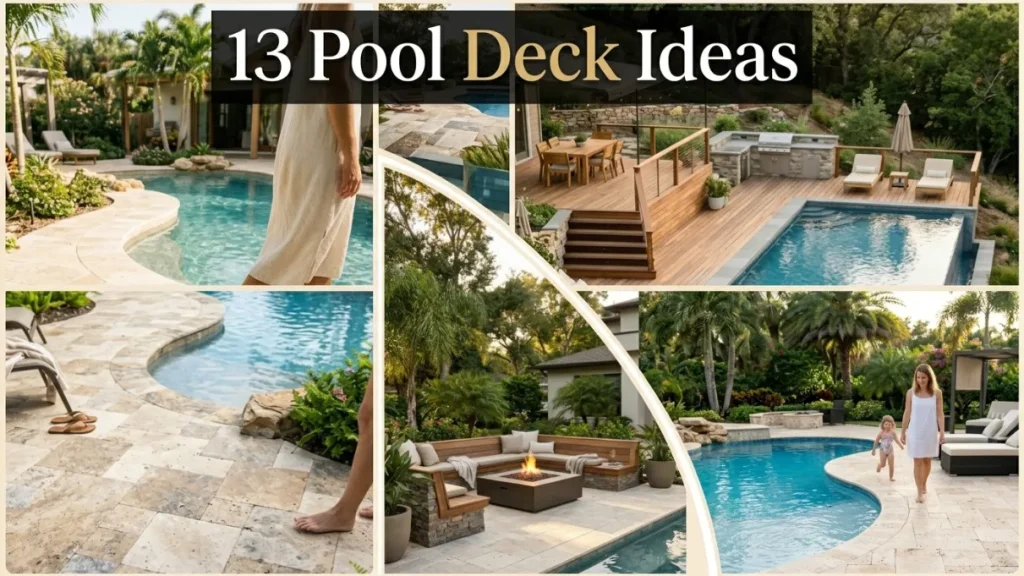
This guide covers 13 pool deck ideas, including materials, styles, and layouts that work in real backyards, not just magazine shoots. Each one includes honest cost ranges, real pros and cons, and tips from actual project experience. Whether you’re working with $8,000 or $80,000, you’ll find something here that fits.
What Makes a Good Pool Deck Before You Pick a Style
Before you fall in love with a look, there are three things worth understanding. They’ll save you money and regret later.
Slip Resistance and Heat Retention
The pool deck is one of the wettest surfaces in your yard. Kids run on it. Adults step off a pool ladder with wet feet. Slip resistance isn’t a bonus feature. It’s a basic requirement.
The industry standard for wet outdoor surfaces is a coefficient of friction (COF) of 0.60 or higher. Most natural stones and textured concrete meet this. Many smooth tiles and polished surfaces do not, unless they carry a specific outdoor-rated designation.
Heat is the other factor most people don’t consider until July. Dark concrete and certain pavers can reach 130°F or more in direct afternoon sun, which is genuinely painful underfoot. Travertine, light-colored composite, and exposed aggregate stay significantly cooler. If your pool gets afternoon sun, material color and porosity matter as much as looks.
The Durability vs. Maintenance Trade-Off
Every pool deck material sits on a spectrum. At one end: natural wood, which looks beautiful but needs sealing or staining every one to three years. At the other end: composite decking and porcelain tile, which ask almost nothing once installed but cost more upfront.
Climate plays a role that often goes underdiscussed. Travertine performs beautifully in Phoenix but can lift and shift in Minneapolis after a few freeze-thaw cycles. Stamped concrete in Minnesota needs proper expansion joints or it’ll crack within a few winters. What works well in one region can fail in another.
How Much Deck Space Do You Actually Need?
A useful rule from professional landscape design: your deck area should be roughly twice the surface area of your pool. For a 400 sq ft pool, that’s about 800 sq ft of deck, enough for lounging, walking the perimeter, and a seating area.
Minimum perimeter walkway width is 36 inches for safety. For busy family pools, 48 inches is more comfortable. If you’re planning outdoor furniture, add that footprint before finalizing your design.
💡 From the field: Homeowners underestimate how much deck they’ll actually use more than any other single decision. Going slightly bigger during the build costs a fraction of what adding on afterward will run you. If you’re on the fence between two sizes, go bigger.
13 Pool Deck Ideas, From Budget-Friendly to Full Luxury
Each idea below covers what it actually costs, where it works best, and what the real-world trade-offs look like. You’ll also find links to related HomeDeckor guides for deeper reading.
1. Stamped Concrete -The Most Versatile Option

Best for: Inground pools, modern or traditional styles, homeowners who want a custom look at a mid-range price
Stamped concrete starts as a standard pour, then gets imprinted with molds before it fully cures. The molds mimic the look of brick, slate, flagstone, or wood. Add integral pigment or surface stain, and you have dozens of color options from a single material.
The appeal is practical: a seamless, joint-free surface with a wide range of looks, all in one pour. Popular pattern choices include Ashlar slate (large irregular shapes), herringbone brick, and cobblestone. Around rectangular inground pools, a large-format slate pattern in a warm gray or sand tone tends to age the best and look the most timeless.
Real cost range: $8–$18 per square foot installed, depending on pattern complexity and region
What works:
- Nearly any color and texture combination is achievable in one material
- No joints means no debris trapping and easier cleaning
- Reseal and re-color in 8–10 years rather than fully replacing
What to watch for:
- Stamped concrete turns slippery when wet unless a non-slip additive goes into the sealer coat; always specify silica sand or aluminum oxide
- Prone to cracking in freeze-thaw climates without expansion joints placed every 8–10 feet
- Color fades over time; the quality of pigment and sealer matters enormously
💡 Pro tip: The single most common stamped concrete regret I hear is “I wish we’d done the non-slip sealer from the start.” It costs $0.50 per square foot more. Ask for it before the pour, not after.
2. Travertine Pavers -The Luxury Look That Stays Cool Underfoot

Best for: Warm climates, freeform or Roman-end pools, homeowners wanting a resort-style finish
Travertine is a naturally formed limestone found near hot springs. Its porosity actually works in your favor: air pockets in the stone reduce heat transfer, so the surface stays noticeably cooler than concrete in direct sun, sometimes 20–30°F cooler.
It pairs best with freeform pools that have curved edges and naturalistic landscaping. Available color families include Ivory, Walnut, Noce, and Silver. The classic installation pattern is the Versailles layout, where four tile sizes mix for an old-world European feel. Simple running bond or stacked patterns give a cleaner, more modern result.
Real cost range: $15–$30 per square foot installed
What works:
- Naturally non-slip surface, even when wet
- Stays significantly cooler underfoot than concrete or dark pavers
- Each piece is unique; natural variation adds character that manufactured materials can’t replicate
What to watch for:
- Needs sealing every two to three years, especially in chlorine splash zones
- Softer than granite and can chip when heavy objects drop or furniture gets dragged
- Not ideal for freeze-thaw climates, since moisture in the pores can cause cracking through winter
💡 Pro tip: Go with a brushed and chiseled edge finish over polished. It hides wear and scratches far better over time and gives you more grip. Two problems solved in one specification decision.
If you’re thinking about the broader pool design alongside the deck, our guide to small backyard pool ideas on a budget covers layout strategies that work well with travertine surrounds.
3. Concrete Pavers – Durable, Practical, and Easy to Repair

Best for: Most pool types, most budgets, homeowners who value long-term practicality
Concrete pavers are pre-cast units available in dozens of sizes, colors, and finishes. Unlike a poured slab, you can lift and replace individual pavers if one cracks, stains badly, or a utility line needs access underneath.
Large-format pavers, 24″x24″ or 24″x48″, give a modern, minimal look that reads as upscale at a mid-range price. Smaller running bond or herringbone patterns suit traditional and transitional styles. For pool applications, look for textured or exposed-face finishes near the water edge rather than smooth-face units.
Real cost range: $10–$20 per square foot installed
What works:
- One cracked paver costs $15–$40 to fix rather than triggering a full resurfacing project
- Wide variety of styles, including options that convincingly mimic natural stone
- Good drainage if installed over a permeable base, since water moves through joints rather than pooling
What to watch for:
- Joints collect algae, dirt, and debris; plan on periodic pressure washing and joint sand replenishment
- Color can fade over time, and quality varies significantly between manufacturers
- Needs a well-compacted base; pavers on poor subgrade will shift and settle unevenly
💡 Pro tip: Use a textured or brushed surface finish on the pavers closest to the pool edge. Smooth-face pavers look great in catalog photos but cause real problems when wet feet are involved.
4. Natural Flagstone – Organic Character That Doesn’t Date

Best for: Freeform pools, naturalistic or cottage garden yards, homeowners who want a one-of-a-kind look
Natural flagstone refers to irregularly shaped slabs of sedimentary rock, most commonly bluestone, limestone, or quartzite. You can set them tight-jointed or with wider mortar joints filled with ground cover, gravel, or decomposed granite.
No two flagstone decks look alike. That natural variation is the whole point. Flagstone works beautifully around freeform pools with curved edges and lots of surrounding plants, particularly in yards with a cottage garden aesthetic. If your backyard leans naturalistic, with lots of texture, greenery, and organic shapes, flagstone fits better than almost any manufactured material.
Real cost range: $15–$35 per square foot installed, higher for premium bluestone
What works:
- Completely natural; no two pieces are identical and there’s no factory-made feel
- Blends well with garden landscaping and water features
- Very durable when installed correctly over a compacted gravel base
What to watch for:
- The uneven surface is a trip hazard, particularly for young children and older family members
- Wider joints require ongoing maintenance to stay clean and stable
- Proper base preparation is critical; this is not a good material for first-time DIYers
💡 Pro tip: If you love the flagstone look but want a safer, flatter surface, ask about tumbled flagstone. Edges get softened in a tumbling drum, surface variation becomes more controlled, and you get the character without the uneven footing.
For yard ideas that pair well with flagstone’s naturalistic feel, our small cottage garden ideas guide is worth a look.
5. Composite Decking – Wood Aesthetics, Low Maintenance

Best for: Above-ground pool decks, elevated platforms, homeowners who want a wood look without annual upkeep
Composite decking boards come from a blend of recycled wood fiber and plastic polymers. They won’t rot, splinter, or fade the way natural wood does. Brands like Trex, TimberTech, and Fiberon are common in pool applications, and from a distance, they read convincingly as wood.
The practical case is simple: you get the warmth of a wood look with dramatically less maintenance. No annual staining, no sanding, no checking for splinters before summer. For above-ground pool platforms and raised deck structures, composite has largely replaced pressure-treated wood in quality builds over the last decade.
Real cost range: $20–$38 per square foot installed
What works:
- No annual staining, sealing, or sanding; the main maintenance is periodic cleaning
- Resistant to moisture, mold, and UV fading on quality products
- Made from recycled content, which gives it a better environmental profile than most hardwoods
What to watch for:
- Darker colors get hot in direct sun, more so than wood
- Higher upfront cost than pressure-treated lumber
- Quality varies considerably between products; budget composite boards have a poor track record for surface mold in humid climates
💡 Pro tip: Choose a co-extruded (capped) composite rather than an uncapped product. The cap is a hard polymer shell that protects the core from moisture and scratching. Uncapped boards cost less but are significantly less durable near water. It’s not a trade-off worth making.
6. Pressure-Treated Wood – Classic, Affordable, DIY-Friendly

Best for: Above-ground pools, budget builds, capable DIYers, deck platforms and walkways
Pressure-treated lumber is softwood, most commonly southern yellow pine, treated with copper-based preservatives to resist rot and insects. It’s been the standard material for above-ground pool deck platforms for decades for good reason: affordable, widely available at every home improvement store, and straightforward to work with.
It takes stain and paint in any color, can be shaped into almost any layout, and holds up for 15–25 years with proper maintenance. For a first pool deck or a platform while you decide on a long-term plan, it’s a reasonable starting point.
Real cost range: $8–$15 per square foot installed, one of the lowest of any option
What works:
- Lowest upfront cost of almost any deck material
- Easy to cut and build, which makes it a practical choice for homeowners with basic carpentry skills
- Takes stain and paint well for any color scheme
What to watch for:
- Needs sealing or staining every one to three years depending on sun and rain exposure; skip this and it deteriorates quickly
- Will check (surface crack), warp, and splinter over time without maintenance
- Modern PT lumber uses copper azole (CA) preservative, which is safer than older arsenic-based formulas, but it still contains chemicals worth knowing about if kids play on the surface regularly
💡 Pro tip: New pressure-treated lumber comes from the mill wet. It won’t absorb stain or sealer properly until it dries. Wait 60–90 days before applying any finish, or it will peel within a year.
7. Exposed Aggregate Concrete – Texture, Grip, and Long-Term Durability

Best for: Family pools, high-traffic areas, homeowners who prioritize slip resistance
Exposed aggregate concrete gets poured like standard concrete, then surface-washed before it fully cures to reveal the decorative stones, pebbles, or glass pieces embedded in the mix. The result is a textured surface with built-in grip and a speckled, natural appearance.
It’s one of the more durable pool deck finishes you can choose. The exposed aggregate layer acts as a wear surface that handles foot traffic without breaking down. It stays cooler than smooth concrete in sunlight, and the texture holds up to pool chemicals and chlorine runoff without degrading.
Real cost range: $10–$20 per square foot installed
What works:
- Among the best slip resistance of any concrete finish, which matters with wet feet
- Very durable; it doesn’t show wear the way stamped concrete eventually does
- Stays cooler than smooth concrete, particularly with lighter aggregate colors
What to watch for:
- Bare feet take some getting used to; the texture feels rough on tender skin, especially for young kids
- Requires a pressure washer for thorough cleaning; a quick rinse won’t cut it
- Aggregate color options are somewhat limited compared to the full palette available with stamped concrete
💡 Pro tip: Specify rounded river pebble aggregate rather than crushed stone. River pebbles have naturally smooth edges. Crushed stone has sharp edges that feel harsh underfoot, particularly on children.
8. Porcelain Tile – Sleek, Modern, and Nearly Zero Maintenance

Best for: Rectangular inground pools, modern homes, homeowners who want a polished finish with minimal upkeep
Large-format porcelain tiles, typically 24″x24″ or larger, installed over a concrete substrate give pool decks a clean, hotel-quality look. Porcelain is denser and less porous than ceramic, so it resists staining, pool chemicals, and UV fading better than most materials.
The visual effect of large-format tiles with tight grout joints on a pool deck is hard to replicate any other way. It reads as genuinely high-end, pairs naturally with modern architecture, and stays looking fresh for years.
Real cost range: $18–$35 per square foot installed
What works:
- Periodic hosing and annual grout sealing covers the maintenance
- Wide range of finishes available, including convincing wood and stone looks
- Pool chemicals won’t stain or damage the surface
What to watch for:
- You must specify outdoor-rated, slip-resistant tile with a COF rating of 0.60 or higher; not all porcelain qualifies, and this matters significantly near water
- Grout joints need cleaning and periodic resealing to stay sharp
- Chips when heavy objects drop on it, and a cracked tile is difficult to replace invisibly
💡 Pro tip: Ask for rectified tiles, which are machine-cut to precise dimensions. They allow tighter grout joints (3mm instead of 6–8mm), producing a cleaner look with less surface area for algae and staining to develop.
9. Rubber or Foam Deck Tiles – A Practical Safety Layer

Best for: Families with young children, above-ground pools, safety zones around hard deck surfaces, budget-conscious buyers
Interlocking rubber or EVA foam tiles aren’t a replacement for a full deck. They work best as a supplement, placed strategically in the wet zones closest to pool entry and exit points. They reduce slip risk and soften landings when kids run, as kids always do.
For above-ground pool owners who want some kind of surface treatment around the pool perimeter without a full build, these are the most accessible starting point.
Real cost range: $2–$8 per square foot, DIY install with no contractor needed
What works:
- Genuinely soft underfoot, which reduces injury severity from slips and falls
- Interlocking install takes hours rather than days
- Drains well, with no standing water pooling on the surface
What to watch for:
- Less visually refined than other materials; works better in a family-first backyard than a design-focused one
- Can shift or buckle on an uneven base
- EVA foam degrades faster than rubber under prolonged sun exposure; treat it as a 3–5 year material
💡 Pro tip: For permanent outdoor installations, choose rubber over foam. EVA foam looks identical on day one but breaks down quickly under UV. Rubber tiles cost a bit more and last significantly longer in a pool environment.
10. Multi-Level Pool Decking – A Smart Solution for Sloped Yards

Best for: Yards with grade changes, homeowners who want distinct activity zones, pools that share a yard with a spa, outdoor kitchen, or fire feature
Multi-level decking is a design strategy rather than a material. Instead of a single flat plane, the deck steps up or down at one or more points, creating distinct areas for swimming access, lounging, dining, or gathering without needing walls or fences to separate them.
This approach is particularly valuable on sloped lots where a single-level deck would require expensive excavation and retaining walls. A thoughtfully designed multi-level layout works with the existing grade rather than fighting it, and the finished result tends to feel more considered and architectural than a flat slab.
Real cost range: Adds 20–40% to standard deck installation costs due to additional framing, steps, and permits
What works:
- Turns a challenging sloped lot into a deliberate design feature
- Creates natural outdoor “rooms” such as a lounging level, a dining level, and a pool-entry level, without any additional structures
- Adds architectural interest that flat decks simply can’t match
What to watch for:
- More complex to design and permit; most jurisdictions require handrails on any step change greater than two risers, and some require engineering review
- Higher cost and longer timeline than a flat build
- Steps need consistent riser height (no taller than 7 inches) and a contrasting edge material for safety at night
💡 Pro tip: If you’re combining a pool with a spa at a different grade, run all the plumbing and electrical in the same trench during the initial build. Adding the spa later costs significantly more and requires tearing into finished work.
11. Pool Deck With a Pergola – Shade That Also Anchors the Space

Best for: High-sun climates, homeowners who want to use the deck into the evenings, anyone who entertains poolside regularly
A pergola is an open-beam overhead structure positioned over a portion of the pool deck. It provides shade during the most intense sun hours, creates a visual anchor that makes the deck feel like a defined room, and gives you a mounting structure for lights, fans, and shade panels.
A 12×16-foot pergola at the far end of the deck, away from the house, creates a shaded retreat zone without blocking the main view of the pool or yard. Even an open-beam pergola with no shade panels provides about 30% sun reduction while keeping the space feeling open.
Real cost range: $3,000–$15,000 for a quality wood or aluminum pergola, not including deck work; aluminum louvered models run $8,000–$20,000+
What works:
- Extends the hours the deck is comfortable to use in summer by a meaningful amount
- Provides a defined gathering spot for dining furniture without requiring a full outdoor room build
- Pre-fab kits make this one of the more accessible large additions for a capable DIYer
What to watch for:
- Open-beam pergolas provide partial shade, not full coverage; a louvered roof or shade sail gives you more control
- Attached pergolas require footings and typically a building permit
- Wood pergolas need staining or sealing every few years to maintain their appearance
💡 Pro tip: Aluminum pergolas with adjustable louvers have become the go-to recommendation across most of the pool projects I’ve consulted on recently. No maintenance, full sun control on demand, and they look sharp. The upfront cost is higher, but the long-term case is easy to make.
For safety considerations around the pool area that interact with pergola placement, our pool fence ideas guide covers barrier requirements by zone.
12. Built-In Seating and Fire Feature – From Swimming Pool to Outdoor Room

Best for: Homeowners who entertain, anyone who wants the pool area to function well in the evenings and shoulder seasons
This idea focuses on the far end of the deck rather than the material itself. Adding built-in bench seating, whether in the same material as the deck for continuity or contrasting stacked stone for visual interest, along with a gas or wood fire pit, turns a swimming pool area into an all-day destination.
A common and effective layout: main pool deck in travertine or concrete pavers, with a slightly raised rear zone featuring a square or circular fire pit surrounded by built-in bench seating with storage underneath. The under-bench storage keeps pool toys, towels, and cushions close at hand without cluttering the deck surface.
Real cost range: Built-in seating adds $1,500–$5,000; a fire pit or fire table adds $800–$4,000+ depending on gas vs. wood-burning and material choice
What works:
- Converts a seasonal swimming spot into a year-round outdoor living room
- Built-in seating reduces the need for moveable patio furniture, which means less clutter and less winter storage to manage
- Fire features increase both evening usability and the overall sense that the space is worth spending time in
What to watch for:
- Gas fire features need a dedicated gas line; check your local utility requirements early in the planning process
- Local codes typically regulate fire pit placement relative to property lines and structures
- Built-in seating is permanent, so choose classic, neutral materials rather than something trend-driven that may feel dated in five years
💡 Pro tip: If there’s any chance you’ll add a gas fire feature eventually, run the gas line during the initial pool deck build, even if you don’t install the fire feature right away. Running it after the concrete and pavers are in place costs three to four times more.
13. Small Pool Deck Ideas – Getting More From a Tight Space

Best for: Compact backyards, small above-ground pools, urban lots, anyone working with under 400 square feet of deck space
Small doesn’t mean compromised. Some of the best-designed pool decks I’ve seen were under 250 square feet. They just required more intentional planning than a sprawling build would.
A few principles that consistently work in tight pool deck situations:
Use large-format tiles or pavers to make the space feel bigger. Fewer grout lines create more visual flow, and the eye reads the surface as more expansive than a grid of small pavers would look.
Mirror the interior flooring material at the pool-adjacent patio area to visually extend the home outward. It blurs the line between inside and outside and makes both spaces feel larger.
Choose light colors across all surfaces. Dark decks absorb visual space along with heat, and in a small yard that’s a real problem affecting how the whole area feels.
Add vertical elements for privacy and interest without consuming floor space. A trellis wall, tall planters, or a climbing-plant structure draws the eye up and makes the space feel intentional rather than cramped. This pairs well with the vertical storage solutions covered in our small shed ideas guide if you’re managing storage in a tight yard too.
Real cost range: $6,000–$15,000 installed, depending on material
What works:
- Lower total cost; less square footage means less material and labor
- Easier to maintain than a large deck
- Focused design attention often produces more refined results than sprawling builds
What to watch for:
- Every square foot counts; poor furniture layout choices are far more noticeable in a small space
- Traffic flow matters more; confirm you can walk the perimeter comfortably before finalizing the layout
💡 Pro tip: Before committing to any small deck layout, use painter’s tape on the ground to mock up furniture placement and walking paths. It costs nothing and catches layout mistakes before the concrete gets poured.
For more on making a compact backyard pool setup work, our small backyard pool ideas on a budget guide is a natural companion to this one.
Pool Deck Materials Comparison
Use this table to narrow down your options before getting contractor quotes.
| Material | Avg. Installed Cost | Slip Resistance | Stays Cool in Sun | Maintenance Level | Best Climate | Best Pool Type |
|---|---|---|---|---|---|---|
| Stamped Concrete | $8–$18/sq ft | Medium (needs additive) | Medium | Low–Medium | Most climates | Inground, modern |
| Travertine Pavers | $15–$30/sq ft | High (natural) | Very Good | Low–Medium | Warm/dry | Freeform, luxury |
| Concrete Pavers | $10–$20/sq ft | Medium–High | Medium | Low | All climates | Most pool types |
| Natural Flagstone | $15–$35/sq ft | High (irregular) | Medium | Medium | Mild–moderate | Freeform, naturalistic |
| Composite Decking | $20–$38/sq ft | High (textured) | Medium | Very Low | All climates | Above-ground, elevated |
| Pressure-Treated Wood | $8–$15/sq ft | Medium | Good | High | Mild–moderate | Above-ground, DIY |
| Exposed Aggregate | $10–$20/sq ft | Very High | Medium | Low | Most climates | Family pools |
| Porcelain Tile | $18–$35/sq ft | High (spec required) | Good | Very Low | Warm/mild | Inground, modern |
| Rubber/Foam Tiles | $2–$8/sq ft | Very High | Good | Very Low | All climates | Safety zones, above-ground |
Cost ranges are national averages as of 2025 and vary by region, contractor rates, and project scope.
How to Choose the Right Pool Deck for Your Budget
Under $10,000 – What’s Actually Realistic
One solid material, a straightforward layout, and getting the basics done correctly. That’s the right goal at this budget. Exposed aggregate concrete or concrete pavers cover a standard above-ground pool surround or a modest inground perimeter well. Pressure-treated wood is the right call for above-ground pool platforms. A well-executed simple deck will serve you better than an underfunded complex one.
$10,000–$25,000 – Where Most Homeowners Land
This range opens up the most choices. Stamped concrete or concrete pavers for the full surround, with room for one added feature: a pergola, a simple fire pit, built-in bench seating, or an upgrade to travertine in a smaller footprint. At this budget, the design can be genuinely considered without feeling stretched.
$25,000 and Up – Full Outdoor Living
Premium materials like travertine or porcelain tile, multi-level design, and multiple features working together: an aluminum louvered pergola, an outdoor kitchen rough-in, a gas fire table, and a full LED lighting package. Projects at this level benefit from working with a landscape designer or pool deck contractor who can coordinate everything into a cohesive plan rather than adding pieces individually.
Observations From the Field
These aren’t design rules. They’re patterns that show up across projects repeatedly, and they’re worth knowing before you commit.
The deck always ends up being the right size or too small. Never too big. Every homeowner who scaled back the footprint to save money eventually wishes they hadn’t. Every homeowner who added a few extra feet is glad they did. Build it once at the size you actually want.
Travertine looks better longer than almost anything else, but neglect it and it shows. It needs sealing, especially in the splash zone. The homeowners happiest with travertine are the ones who sealed it on schedule. The ones who aren’t happy are the ones who didn’t.
Test how hot your material gets before you commit. Put a dark concrete paver in direct afternoon sun for 20 minutes, then step on it barefoot. That’s what your deck will feel like at 3pm in August. If that’s a problem for how you’ll use the space, choose something lighter.
A pergola, good lighting, and a small fire feature is the highest enjoyment-per-dollar combination I’ve seen at any budget. It takes a daytime pool area and turns it into a place people want to stay after sunset. If you can only add one thing beyond the basic deck surface, add this.
Gas lines are cheap to run during the build and expensive to add afterward. If there’s any chance you’ll ever want a gas fire feature, outdoor kitchen, or gas heater near the pool, run the line while everything is still open. It’s a $300–$600 add-on during construction and a $2,000–$4,000 project after.
If you’re also thinking about an indoor pool setup, our indoor pool ideas guide covers design approaches for enclosed aquatic spaces with a different set of material and ventilation considerations.
Frequently Asked Questions
What is the best material for a pool deck?
There’s no single best material. The right choice depends on your climate, budget, and how you use the space. Travertine pavers consistently perform well across safety, appearance, and longevity in warm and mild climates. In freeze-thaw regions, concrete pavers or exposed aggregate concrete are more reliable choices. If low maintenance is your top priority and budget allows, composite decking for above-ground pools or porcelain tile for inground pools are both strong long-term options. The non-negotiable for any material: it needs to be slip-resistant when wet.
How much does it cost to build a pool deck?
A basic concrete or paver deck around a standard inground pool typically runs $10,000–$20,000 for 600–800 square feet. Mid-range builds with travertine or stamped concrete plus a pergola or fire pit generally land between $20,000–$40,000. Full outdoor living builds with multi-level design, premium materials, and multiple features can reach $50,000 or more. The biggest cost variables are material choice, regional labor rates, and layout complexity. Always get at least three quotes from licensed contractors and ask them to separate material costs from labor so you can compare fairly.
Can I add a deck to my existing above-ground pool?
Yes, and it’s one of the better investments you can make for an above-ground pool. A wood or composite platform deck makes the space feel more permanent, adds real safety by eliminating the need to climb over the pool wall, and significantly improves how the backyard looks and functions. A basic pressure-treated wood deck for a standard above-ground pool typically costs $3,000–$8,000 installed depending on size and site conditions. It’s also one of the more accessible DIY projects for someone with basic carpentry skills and a free weekend.
Conclusion
Thirteen ideas, every material type, every budget range from $2-per-square-foot rubber tiles to full-luxury travertine with a multi-level layout and a louvered pergola. The right answer for your deck sits at the intersection of your climate, your budget, and how you actually plan to use the space.
The decision process that works best: pick a material that suits your climate first, filter by budget second, then ask how you’ll realistically use the space day-to-day. A family with three kids who swim every afternoon needs a different deck than a couple who hosts occasional evening dinners poolside. Neither is wrong. They just call for different solutions.
The more specific you can be with your contractor about materials, layout priorities, and intended use, the better your quotes will be. Bookmark this guide for those conversations. Having a vocabulary for what you want saves time and avoids the “well, what we usually do is…” default that doesn’t always fit your situation.