
Victorian kitchens have stayed relevant for a simple reason: the style rewards attention to detail. Rich colors, carved woodwork, patterned tile, and ornate hardware create kitchens that feel warm, considered, and lived-in. Whether you are renovating a period property or building that character into a new home, there is no single formula. The ideas below cover the full range, from faithful historical recreations to modern kitchens that borrow only the best Victorian details.
This guide covers 40 Victorian style kitchen ideas organized by theme, followed by practical sections on color, cabinetry, flooring, and countertop selection, plus answers to the questions homeowners ask most.
What Is a Victorian Style Kitchen?
The Victorian era ran from 1837 to 1901, and the design vocabulary of that period was anything but restrained. Symmetry, ornamentation, and quality materials were the priorities. Kitchens of the time featured dark wood cabinetry, patterned tile floors, high ceilings with plasterwork detail, and cast-iron ranges as the dominant focal point.
Today, a Victorian style kitchen draws on those same elements, scaled and adapted for modern living. The defining traits are:
Key Characteristics

Ornate cabinetry. Raised-panel or beadboard doors with decorative moldings, glass inserts, and carved details. Wood species are typically mahogany, walnut, or oak, stained dark or painted in period colors.
Rich color palettes. Deep burgundy, forest green, navy blue, black, and chocolate brown dominate. Lighter versions use cream, soft gray, and powder blue as the primary tones, with dark accents keeping the connection to the period.
Patterned tile. Both floors and backsplashes use tile as a decorative element, not just a functional one. Black-and-white checkerboard, encaustic geometric patterns, floral motifs, and handpainted designs are all authentic to the period.
Brass and gold hardware. Knobs, pulls, faucets, and light fixtures in antique brass, unlacquered brass, or burnished gold tie the room together. Porcelain knobs with brass mounts are also period-accurate.
Statement lighting. Chandeliers, wall sconces, and pendant lights with glass globes or lantern shades add visual weight and reinforce the historic mood.
Crown molding and trim. Decorative plasterwork on ceilings, dentil molding on cabinets, and wood trim around doors and windows are what separate a Victorian kitchen from a kitchen that simply has dark cabinets.
Victorian Kitchen Color Palette
Color is the fastest way to establish or destroy a Victorian mood. The choices below all work, but they produce different atmospheres in the same space.
Dark and Dramatic: Jewel-Tone Kitchens
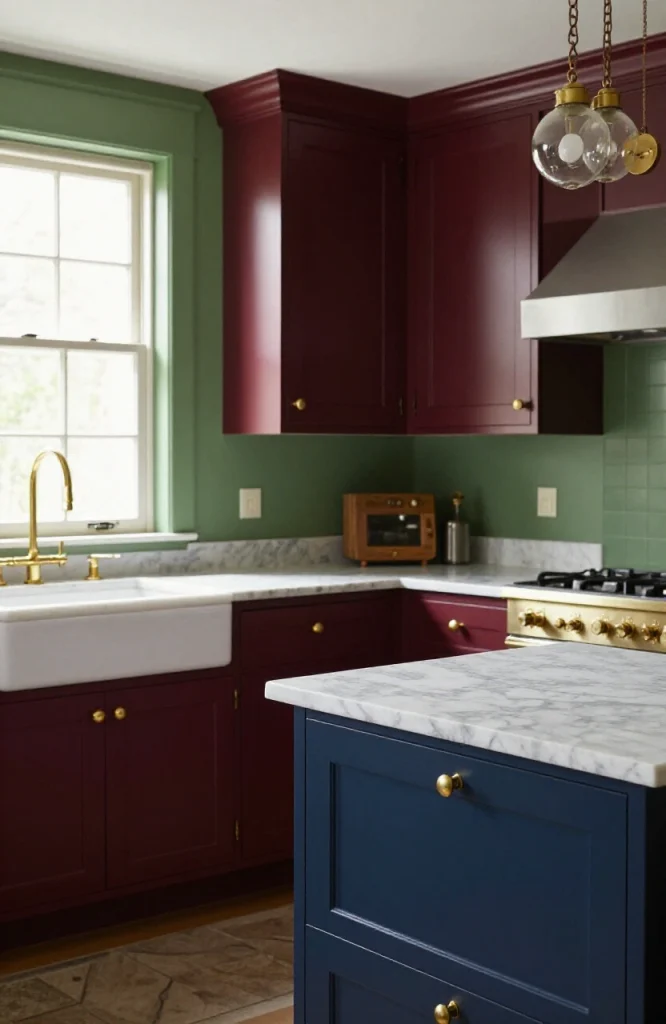
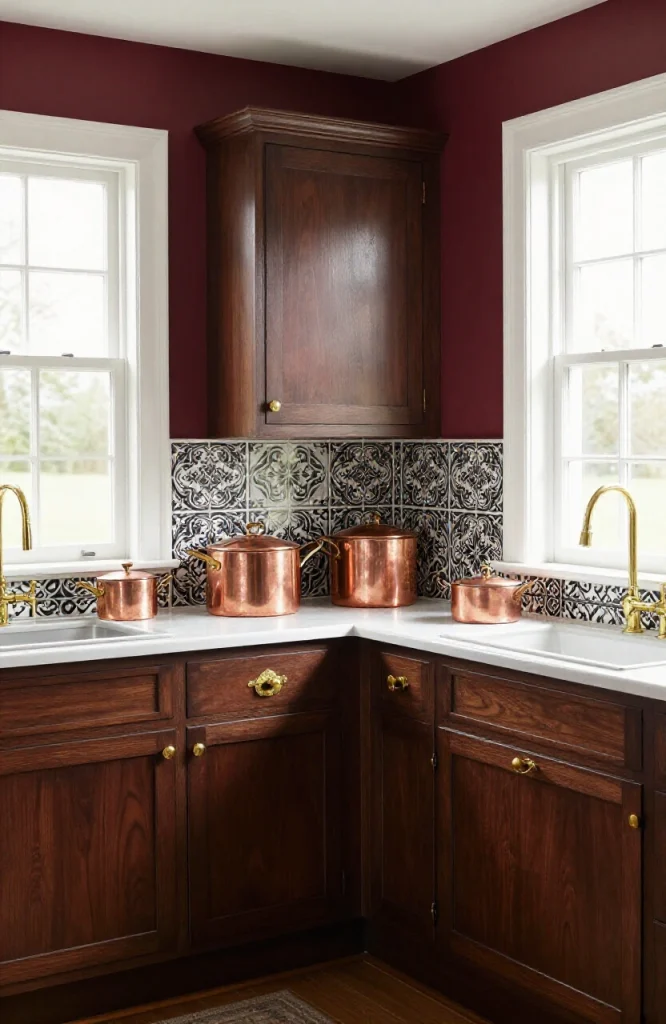
Deep burgundy, forest green, and navy blue create the most historically accurate mood. These colors absorb light rather than reflect it, which makes the room feel intimate rather than open. They work best on cabinets paired with marble or granite countertops and gold hardware. If the kitchen has good natural light, this combination is striking. In a poorly lit space, balance it with cream upper cabinets or white ceiling paint.
Light and Elegant: Ivory, Gray, and Soft Blue
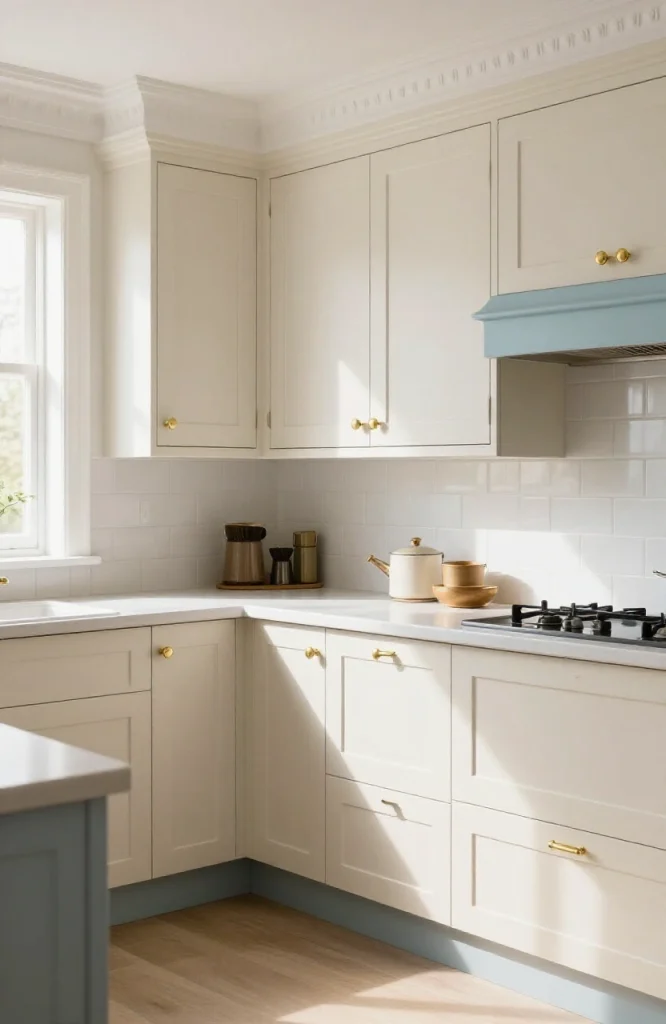
Not every Victorian kitchen has to be dark. Cream, pale gray, and powder blue cabinets with brass hardware give a lighter reading of the style that suits smaller kitchens well. The key is keeping the ornate details, such as crown molding, glass-front cabinets, and patterned backsplash tile, so the lightness does not drift toward generic farmhouse.
Two-Tone Cabinet Color Combinations
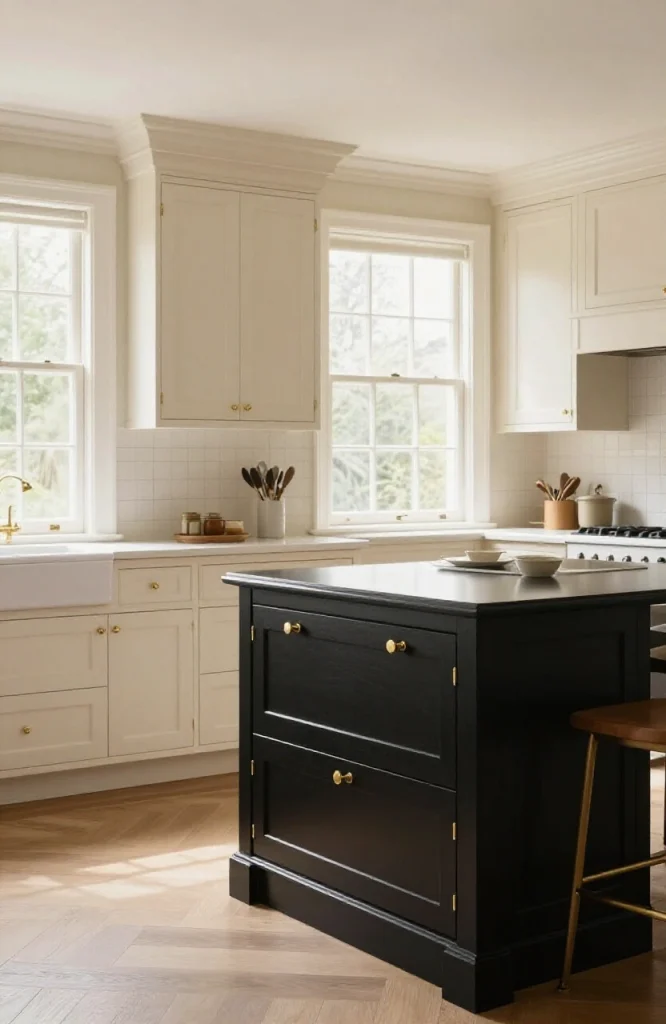
Victorian kitchens used furniture-style cabinetry rather than fitted runs, which makes two-tone approaches feel natural. Some combinations that work well:
- Black island, cream perimeter cabinets, brass hardware
- Navy lower cabinets, white upper cabinets, gold pendant lights
- Dark green base cabinets, off-white uppers, marble countertops
- Charcoal lower cabinets, pale gray upper cabinets, unlacquered brass pulls
For more on building a room around a specific color, see the sage green bedroom ideas guide on this site, which covers how to balance a dominant color without overwhelming a space.
Classic Victorian Kitchens
1. Dark Mahogany Cabinets with Antique Brass Cup Pulls
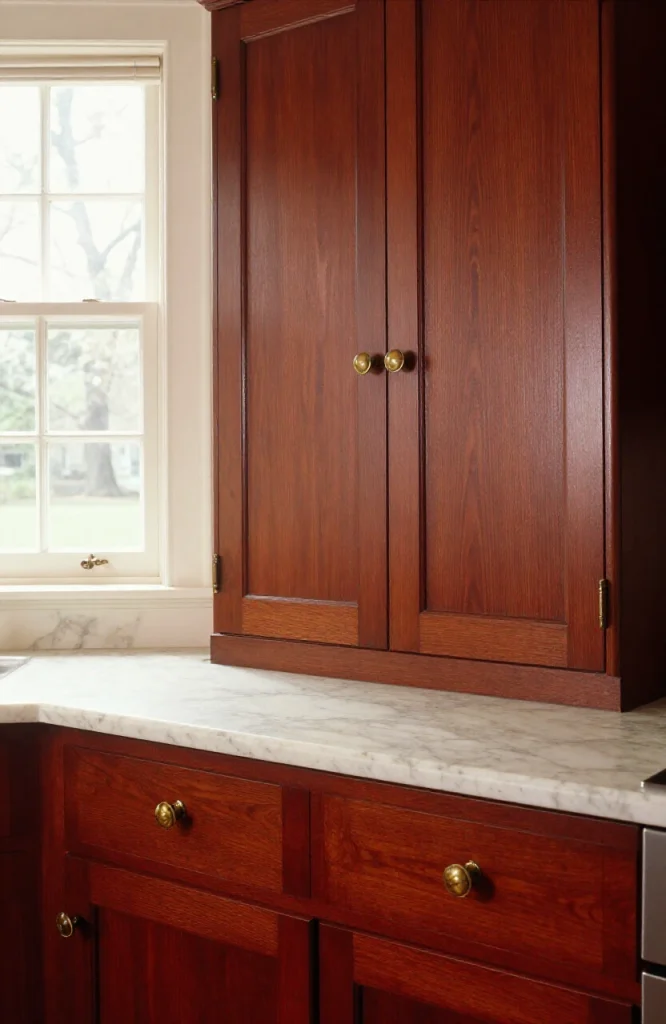
Raised-panel mahogany doors in a deep reddish-brown stain. Antique brass cup pulls on base cabinets, bin pulls on drawers. Pair with cream or white marble countertops — the contrast keeps the room from going too dark. Ceiling-height cabinets with dentil crown molding lock in the period character.
2. Black-and-White Checkerboard Encaustic Tile Floor
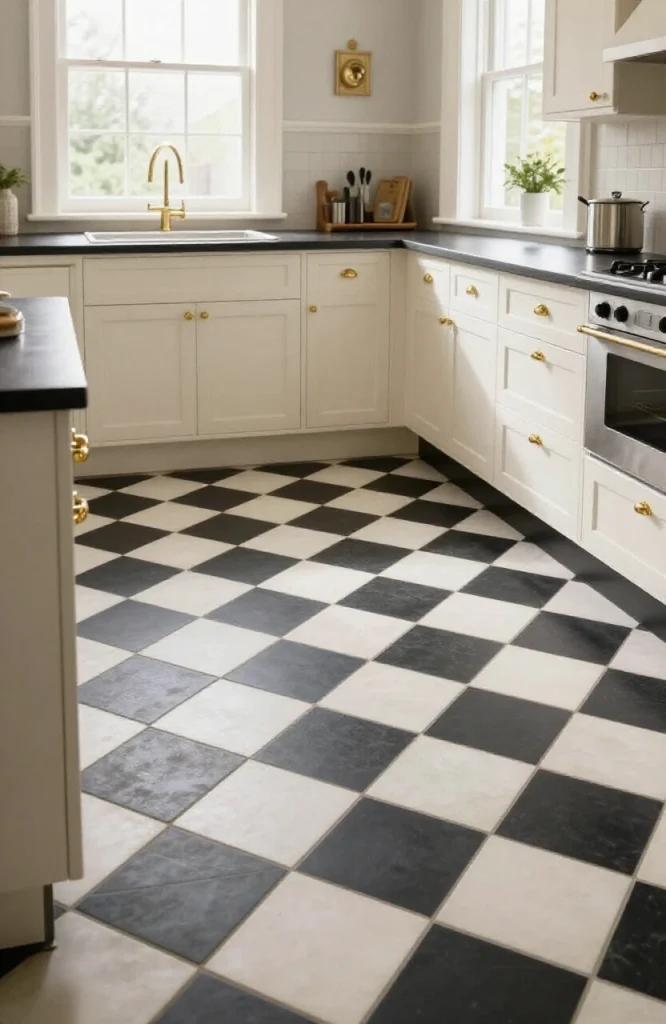
Unglazed encaustic tiles at 8×8 or 12×12 in a straight checkerboard layout. The matte finish is more period-accurate than polished ceramic. Grout in dark charcoal hides grime and stops the grid from bleeding. Sits well under both dark and light cabinetry without competing with either.
3. Cast-Iron Range with Exposed Brick Surround
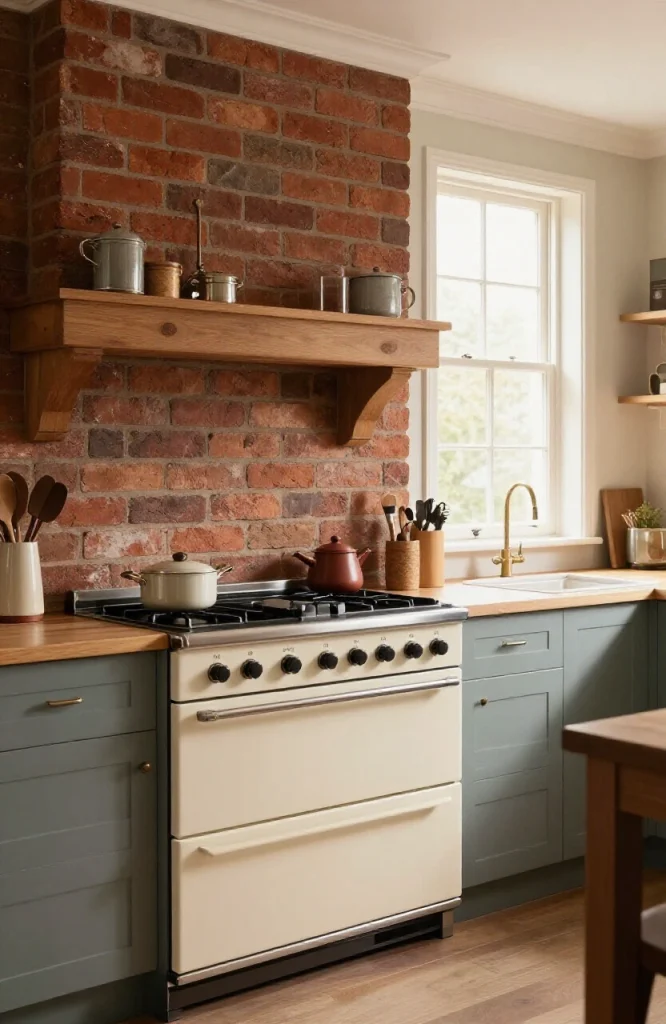
An AGA or retro-styled range in cream, black, or dark red becomes the dominant focal point. Frame it with exposed brick on three sides or a hand-painted tile niche. Add a simple wooden mantel shelf above for display. Everything else in the kitchen subordinates to this piece.
4. Built-In Plate Rack and Open China Display Above the Sink
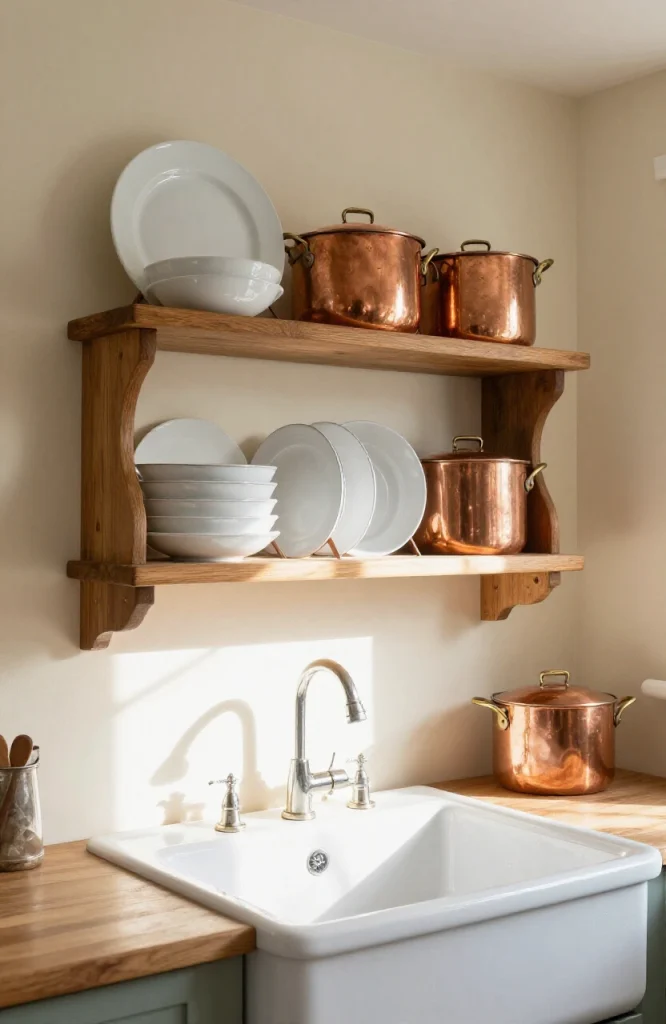
A wall-mounted timber plate rack with slotted slots for drying and display, positioned directly above the sink. Bracket-supported open shelves to each side hold white ironstone stacks, copper pots, and glass storage jars. Eliminates the need for upper cabinet doors on that run and adds texture to the room.
Recommended: 17 Open Shelving Kitchen Ideas: Pros and Cons
5. Herringbone Dark Oak Floor with Ceiling-Height Crown Molding
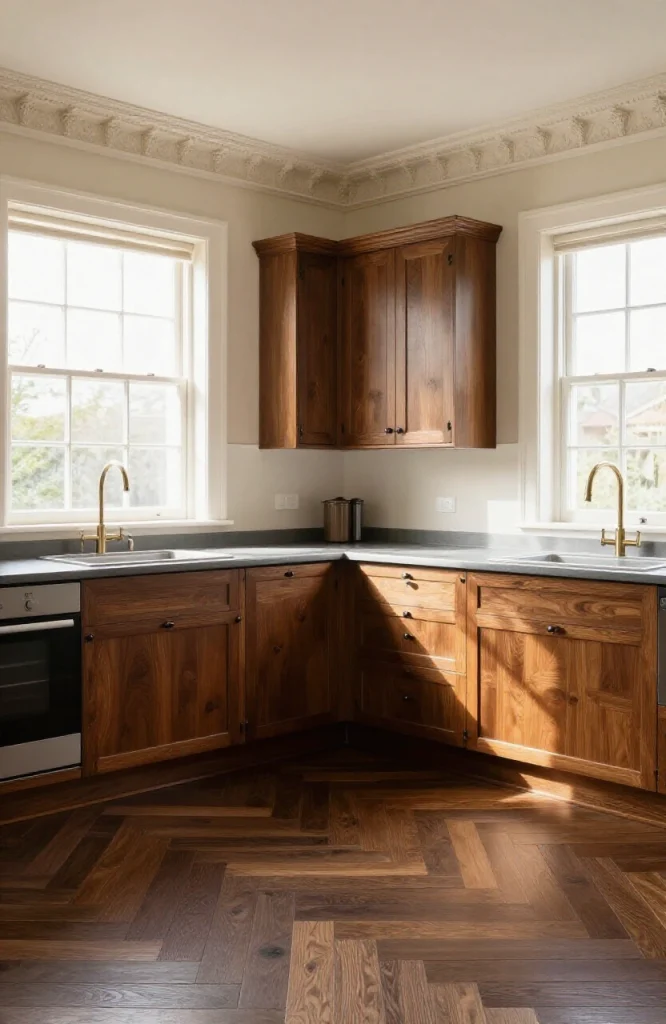
Dark walnut or ebony-stained oak in a herringbone parquet layout. The directional pattern adds visual complexity without pattern on the walls. Match the crown molding profile to the cabinet detailing — egg-and-dart or dentil in a room with carved cabinetry, simple ogee in a painted shaker kitchen.
6. Butler’s Pantry Alcove with Glass-Front Upper Cabinets
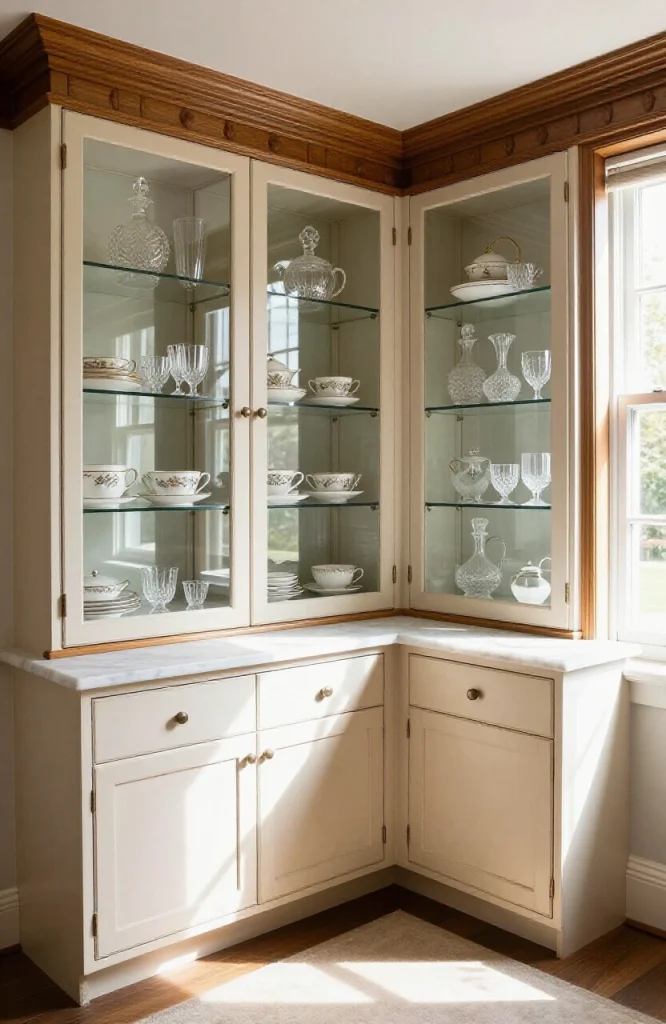
A recessed pantry alcove off the main kitchen with glass-front upper cabinets on three sides displaying glassware, china, and decanters. Lower cabinets handle dry goods. A small marble-top counter inside gives prep space. Even a 1.2m-wide alcove reads as a full butler’s pantry in period photographs.
7. Stained Glass Window Above the Sink
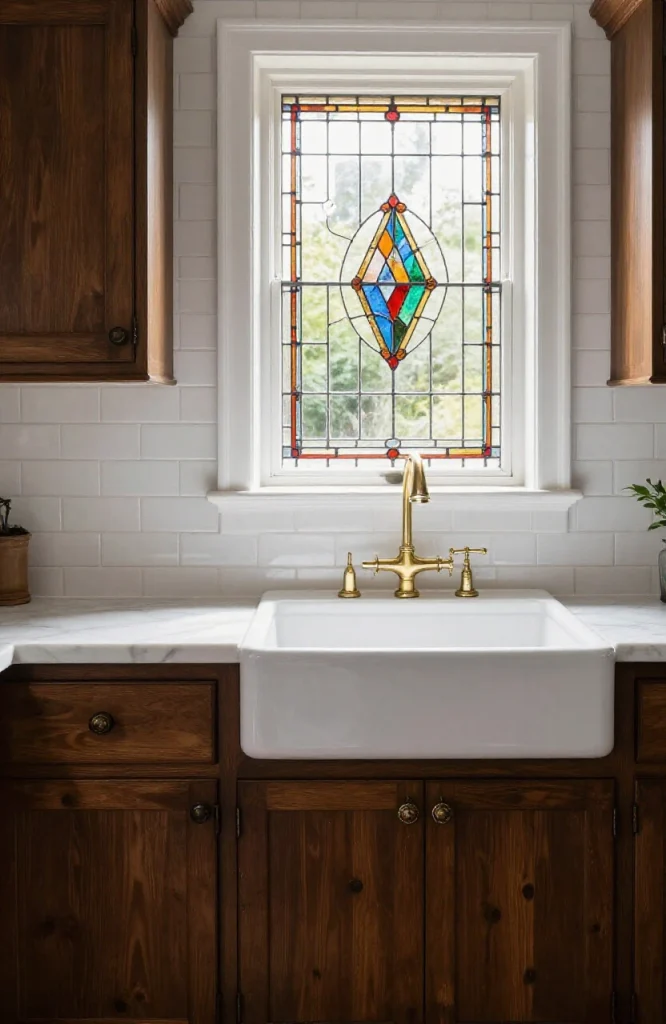
A leaded stained glass panel in a botanical or geometric Victorian pattern fitted into the window frame above the sink. Casts colored light into the room during daylight. Reproduction panels are manufactured to measure and fit into standard frame openings without structural alteration. Provides privacy without a blind.
8. Forest Green Shaker Cabinets with White Marble and Patterned Tile Backsplash
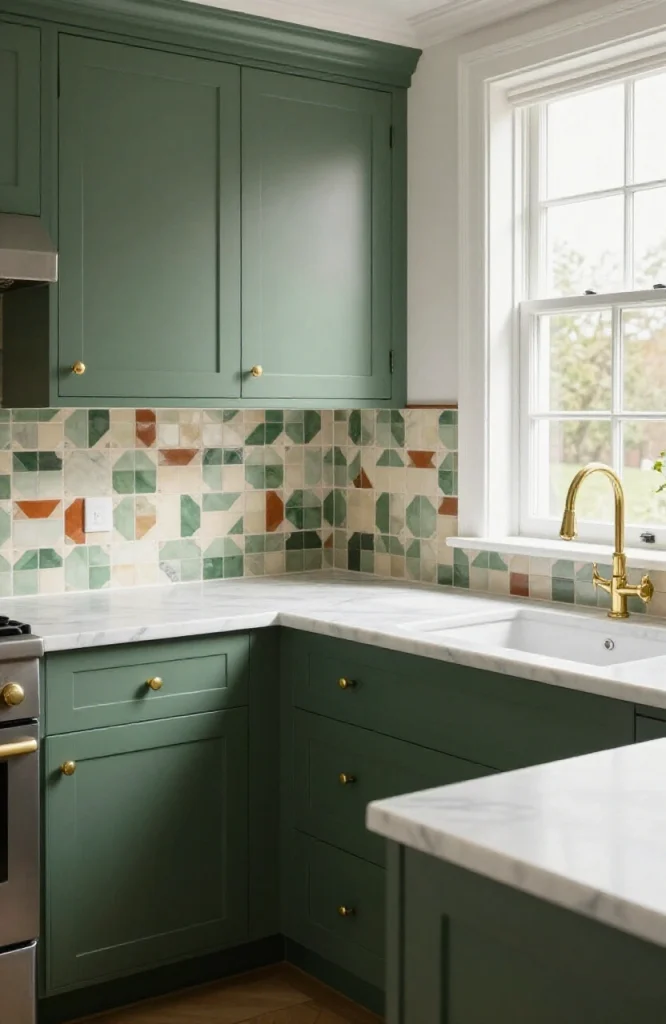
Bottle green or forest green painted shaker doors. White Carrara marble or quartz countertops. A handpainted or encaustic geometric tile backsplash in green, cream, and terracotta. Antique brass hardware throughout. The shaker door is simple enough not to compete with the tile while the color and hardware keep the Victorian reference strong.
Modern Victorian Kitchens
9. White Shaker Cabinets with Victorian Molding Detail and Brass Hardware
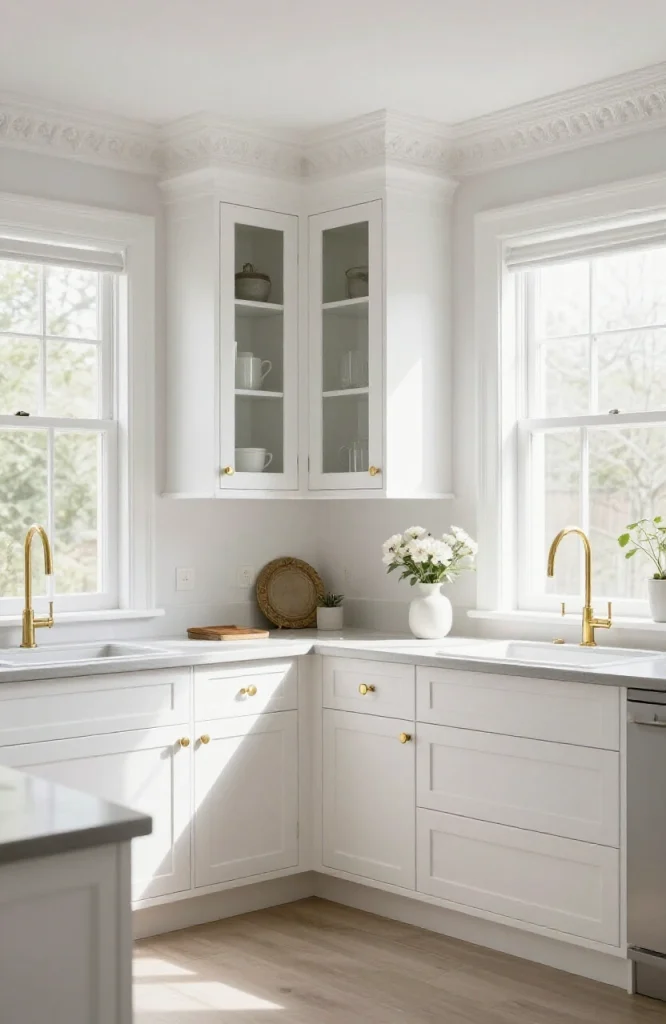
Standard shaker-door base cabinets, but add applied dentil or egg-and-dart crown molding at ceiling height, glass-front inserts in two or three upper doors, and antique brass hardware on every door and drawer. The cabinet profile stays budget-friendly; the surrounding detailing pulls the room into a Victorian reading.
10. Flat-Front Dark Cabinets with Large Brass Bin Pulls and Victorian Tile
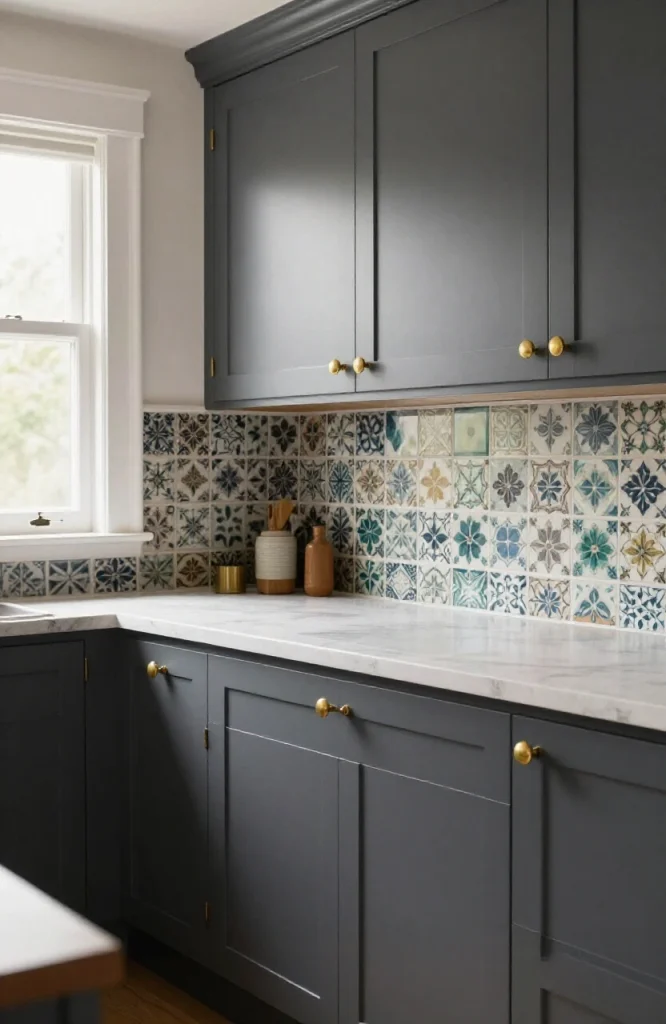
If carved cabinetry is out of budget, use flat-front doors in charcoal or deep navy. Large antique brass bin pulls — 160mm or 192mm bar length — on every door. A patterned encaustic backsplash and a brass pendant above the island carry the period character. The hardware and tile do the decorative work the cabinet profile cannot.
11. Dark Walnut Cabinetry with Stainless-Steel Professional Appliances
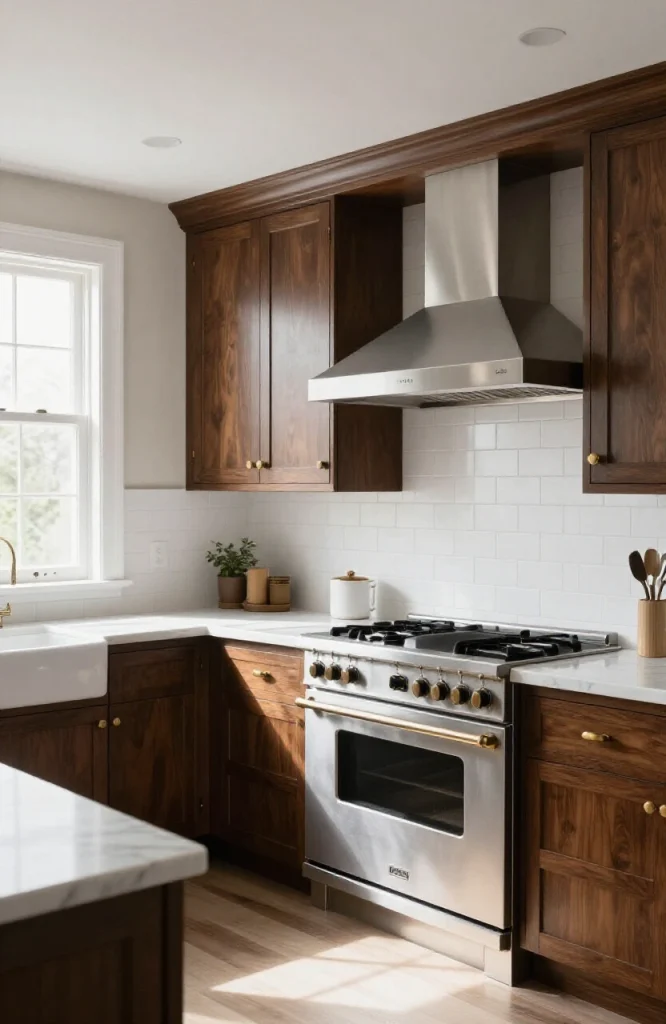
The industrial revolution was a Victorian story, so steel appliances sit closer to the period than they appear. Dark walnut raised-panel or flat-front cabinets with a white subway tile backsplash in dark grey grout and stainless-steel professional range and hood. The walnut’s warmth absorbs the steel’s coldness and keeps the room coherent.
12. Walnut Lower Cabinets, Off-White Glass-Front Uppers, Herringbone Tile Floor
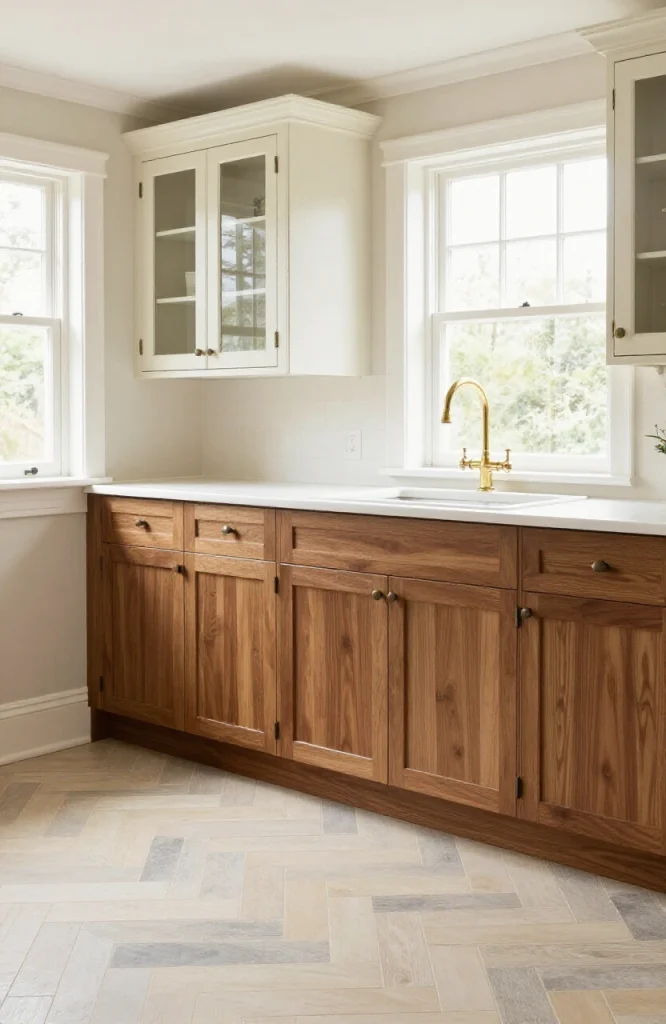
Walnut flat-front base cabinets for warmth at counter level. Off-white upper cabinets with glass-front doors to lighten the top of the room. A brass bridge faucet at the sink, a herringbone tile floor in a warm cream, and brass pendant lights. The room sits between mid-century and Victorian without fully committing to either.
13. Victorian Terrace Open-Plan Kitchen Retaining Period Features
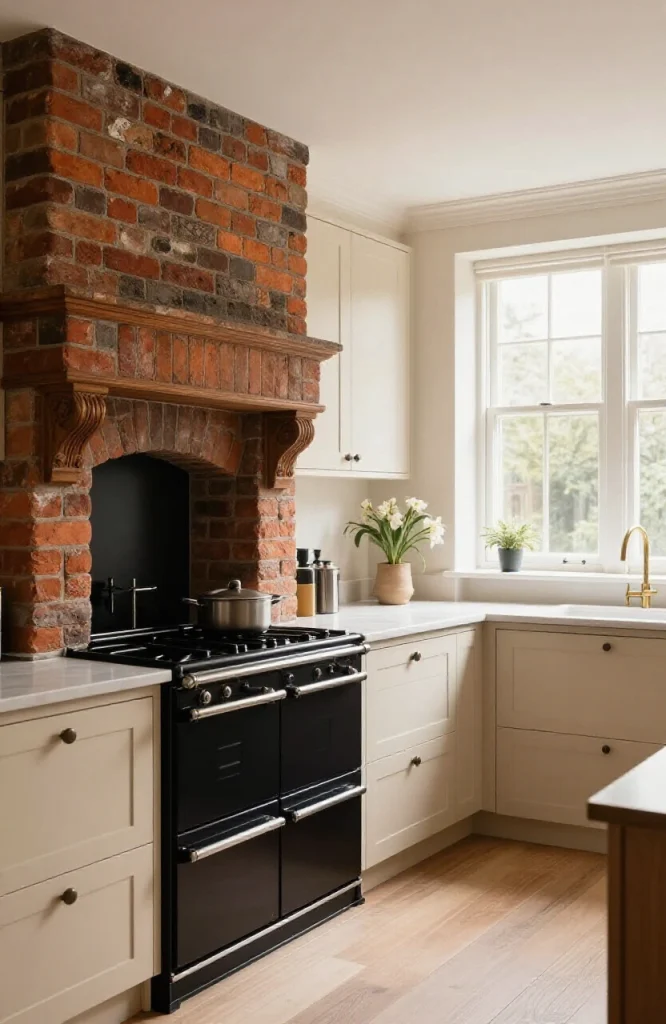
Take the wall between the rear kitchen and back reception room to get the length modern living needs. Keep the chimney breast in the kitchen side as a range surround, retain the original corbels on the RSJ beam, and preserve sash window details on the rear elevation. The period features remain load-bearing in a visual sense even after structural work.
14. Matte Black Cabinetry with Carved Hood, Brass Accents, and Open Shelving
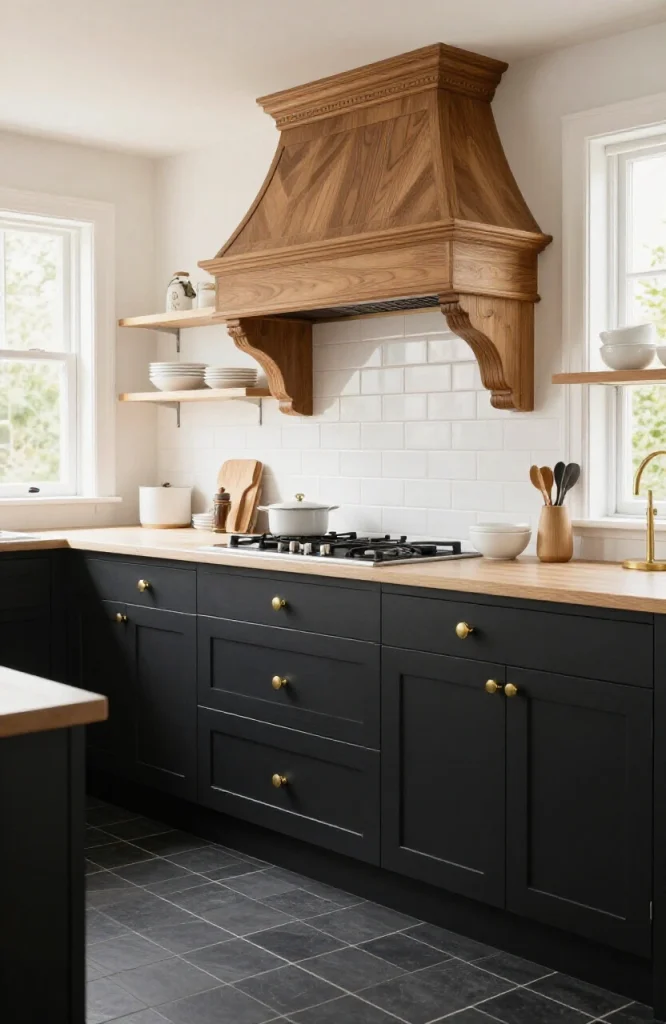
Matte black flat-front or shaker cabinets, black hardware, dark grout tile floor. Without period detailing this reads as contemporary. Add a wood-paneled range hood with carved corbel brackets, unlacquered brass faucet and light pendants, and one run of open shelving with ceramic dishware to anchor the room in Victorian territory.
15. Beaded Inset Cabinets in Cream with Farmhouse Apron Sink and Brass Bridge Faucet
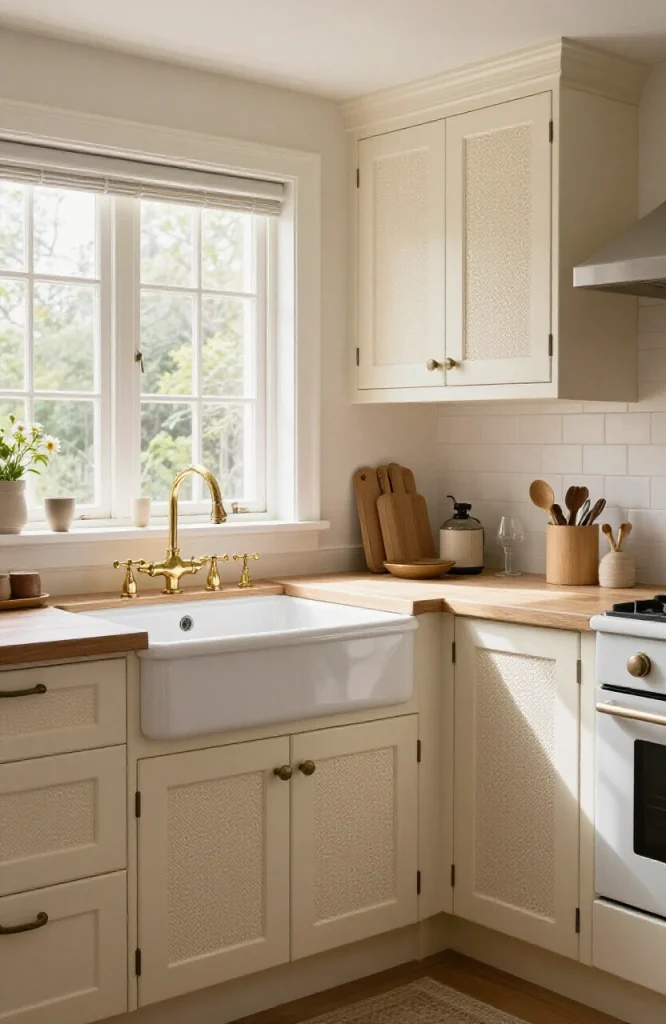
Beaded inset doors — where the door sits inside the face frame with a narrow reveal — in a painted cream finish. A white cast-iron or fireclay apron front sink. A brass bridge faucet with cross-handle valves. Shiplap paneling above the backsplash tile. The beaded inset profile places this in the Victorian camp over the farmhouse one.
16. Soft Gray Cabinets with Gold Hardware, Marble, and Hexagon Tile Floor
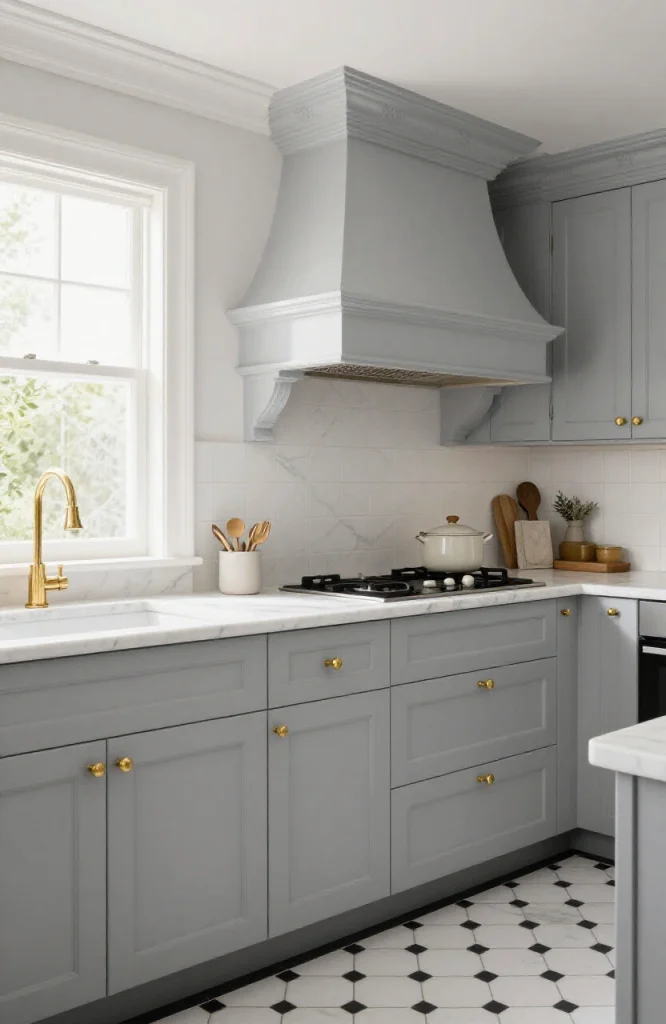
Pale gray raised-panel cabinets with satin gold bar pulls. White marble countertop with moderate veining. A decorative range hood with molded plaster or wood surround. Black-and-white hexagon tile floor in a 2-inch module. The combination references both Parisian and Victorian sensibilities without being overtly historic.
Victorian Kitchen Cabinetry Ideas
Victorian cabinetry is the single most impactful element in the style. The ideas below cover different approaches depending on budget and kitchen size. For more kitchen planning resources, browse the kitchen category on this site.
17. Raised-Panel Doors with Applied Carved Molding on the Frame
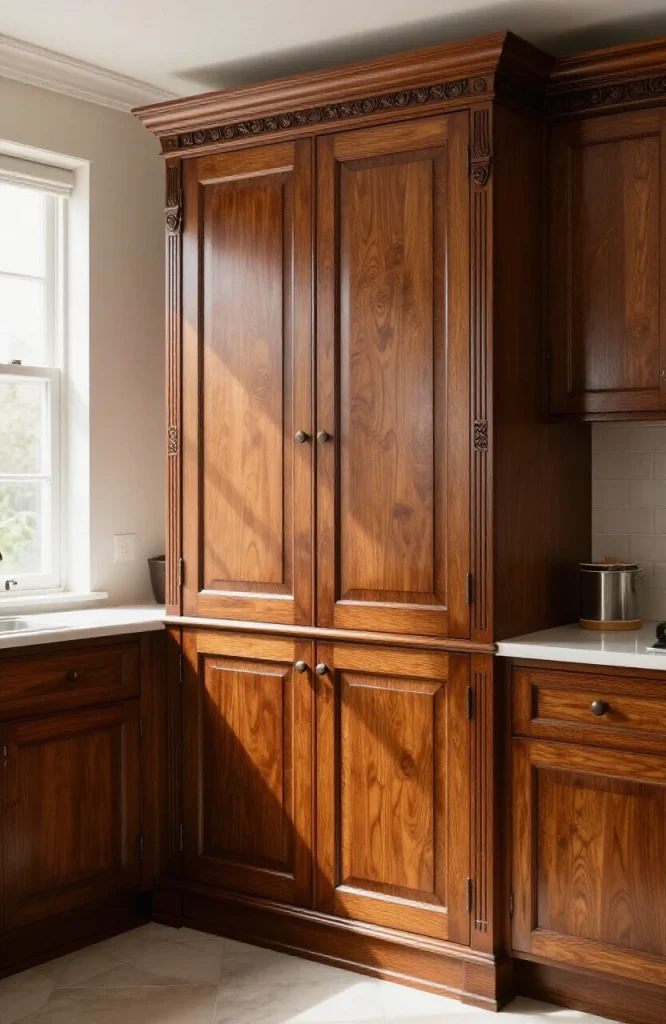
Raised-panel doors in mahogany, walnut, or oak with a secondary decorative molding applied to the outer face frame. The carved molding adds three-dimensional shadow detail that photographed and in-person light brings to life. Stain dark or paint in a deep Victorian color. This is the highest-cost cabinet option and the most historically accurate.
18. Glass-Front Upper Cabinets for Dishware and Copper Display
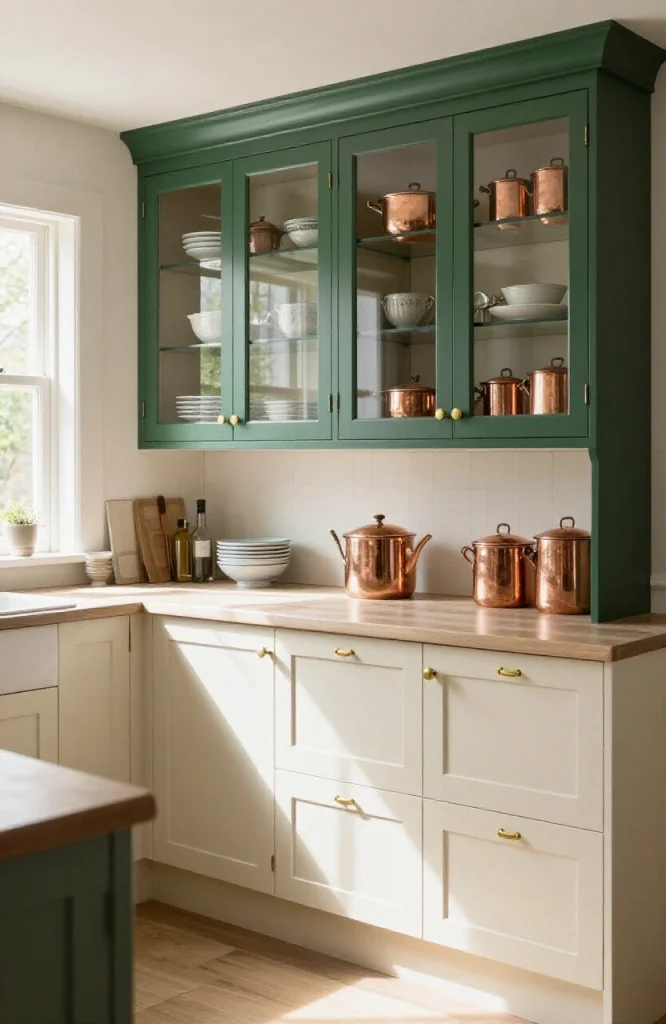
Replace solid upper cabinet doors with clear or seeded glass panels in a divided-light configuration — 4 or 6 panes per door. Back the interior with a contrasting paint color, darker than the cabinet exterior. Display white ironstone stacks, cut glass, and copper pieces. The glass breaks up a solid run of upper cabinets and adds depth to the room.
19. Ceiling-Height Cabinetry Wall with a Rolling Library Ladder on a Brass Rail
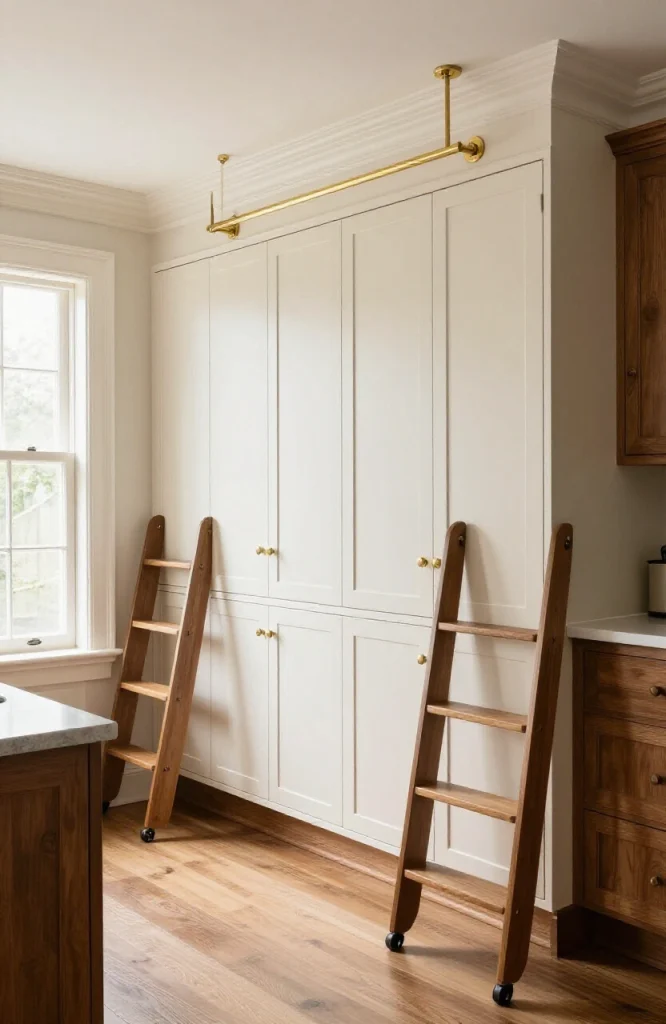
A full wall of floor-to-ceiling cabinets, the top third used for infrequent storage. A brass rail fixed 300mm from the ceiling carries a rolling ladder on wheels. The ladder references Victorian library design and turns a utilitarian storage wall into a room feature. The rail must be load-rated for a person’s weight — budget accordingly.
20. Beadboard Cabinet Doors in Cream or Sage for Smaller Kitchens
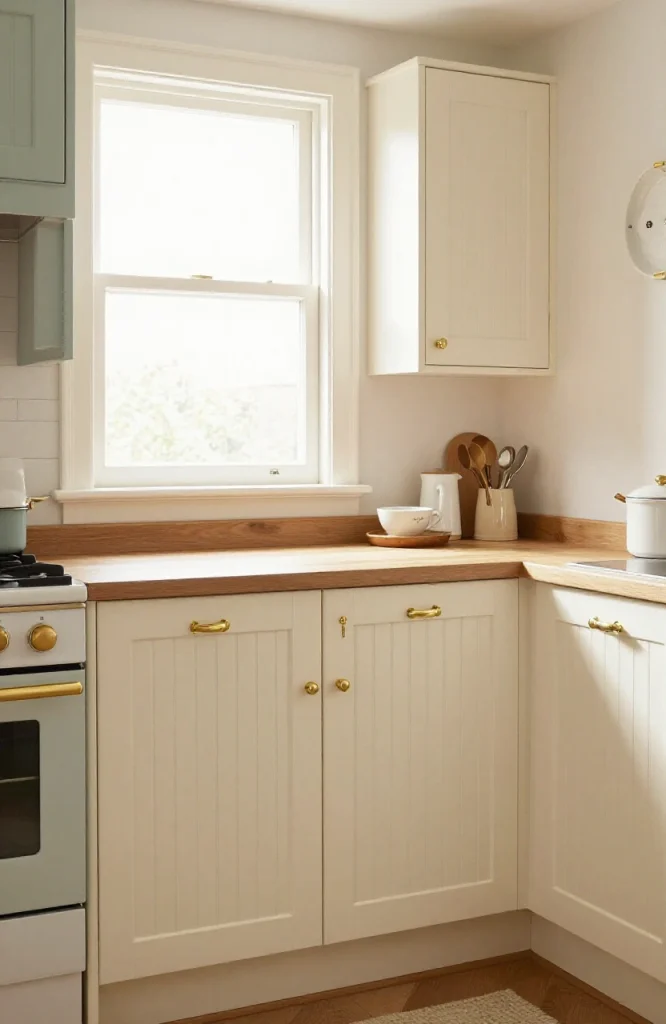
Vertical beadboard paneling routed into a flat-frame door produces a cottage-Victorian reading that suits smaller rooms better than heavily carved cabinetry. In cream with porcelain-and-brass knobs and a tile floor, it reads as Victorian cottage. In sage green with brass hardware, it reads as a lighter take on the forest-green Victorian palette.
21. Navy Lower Cabinets, White Upper Cabinets, Two-Tone Separation
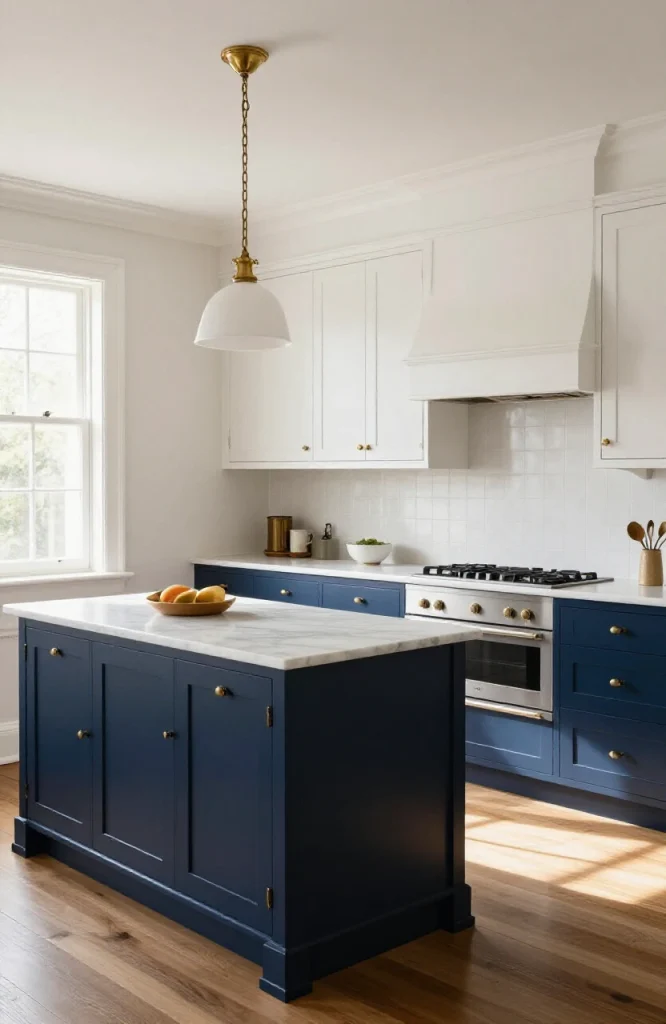
Dark navy or bottle green on all base cabinets and the island, off-white or antique white on all upper cabinets. The visual divide at countertop height grounds the room without making the ceiling feel lower. White uppers reflect more light, which compensates for the light absorption of the dark lowers in a kitchen with limited windows.
See also: Kitchen Backsplash Color Ideas: Transform Your Space
22. Custom Wood Range Hood with Carved Corbel Brackets
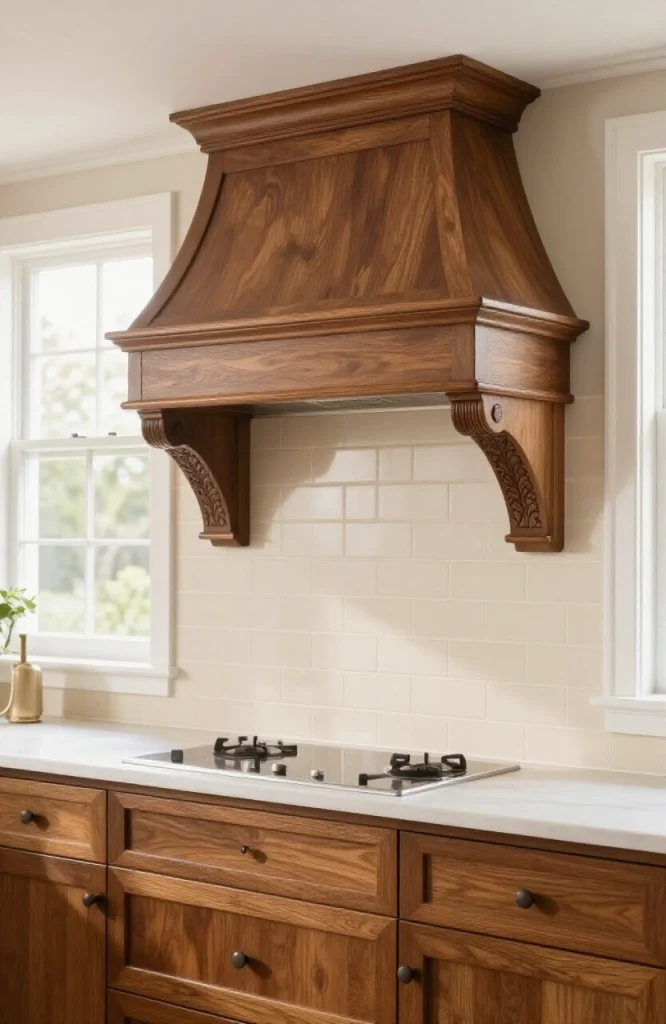
A paneled wood hood surround built to match the cabinet species and finish, widening from the duct width above to a full-width mantel below. Carved wood corbel brackets at the two lower corners. A small shelf along the bottom for display. The hood becomes the decorative centerpiece of the room — the single highest-return upgrade in a Victorian kitchen renovation.
Victorian Kitchen Flooring Ideas
23. Classic Black-and-White Encaustic Checkerboard
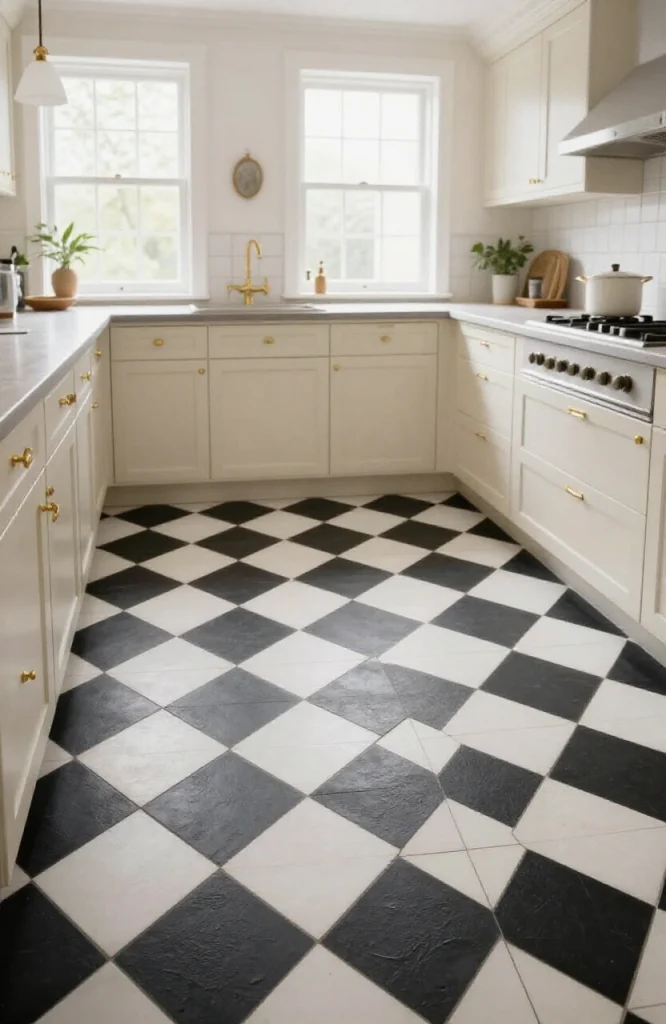
Unglazed cement-body encaustic tiles in an 8×8 or 10×10 format. The matte, slightly textured surface is more period-accurate than polished ceramic or porcelain. Dark charcoal grout stops the grid from visually breaking apart across joints. Encaustic tiles need sealing on install and resealing every few years, but they age well and harden over time.
24. Wide-Plank Dark Hardwood in Ebony or Dark Walnut Stain
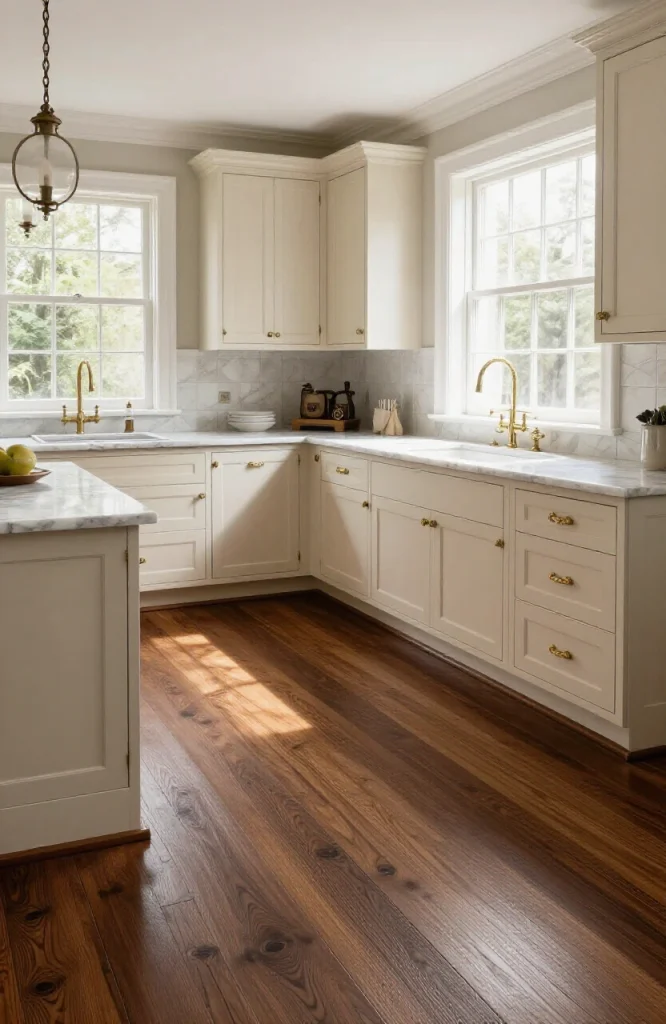
Oak or ash boards at 150mm–200mm width, stained in ebony or dark walnut. Wider planks show fewer joints and read more generous than narrow strip flooring. Dark wood is warmer underfoot than stone or tile, which matters in a kitchen used for long cooking sessions. Connects naturally to dark cabinet finishes without competing.
25. Multi-Color Geometric Victorian Ceramic Tile in Black, Red, and Cream
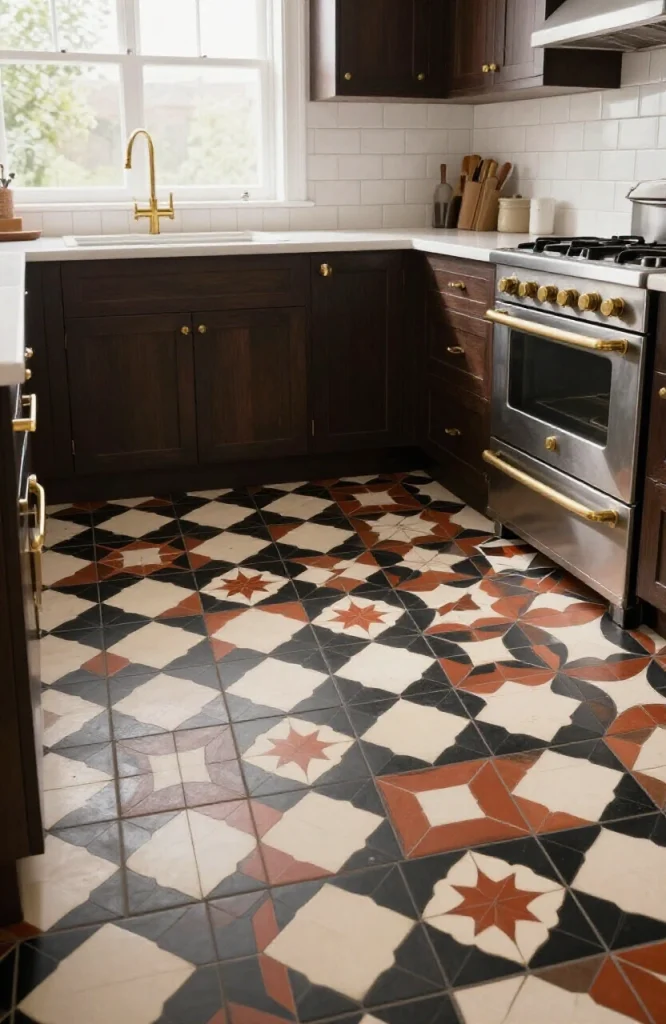
A three-color geometric repeat in encaustic or ceramic tile — black, terracotta red, and cream or buff. Common Victorian patterns include quatrefoil, interlocking diamonds, and eight-pointed star modules. This floor has strong visual presence and reads as distinctly Victorian from the room entrance. Keep the cabinetry in a single solid color so the floor reads clearly.
26. Chevron Dark Oak as an Alternative to Herringbone
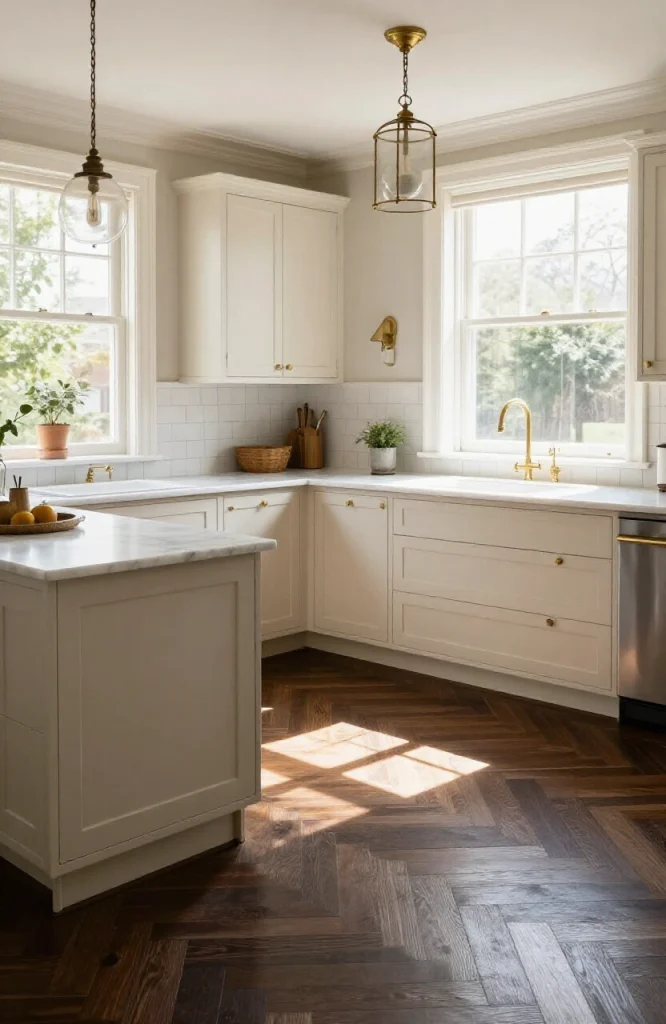
Chevron differs from herringbone in that each board is cut at a 45-degree angle and meets at the apex, creating a sharper V-shape. In a dark-stained oak it produces a more refined, almost formal floor pattern. Works in both classic and modern Victorian kitchens without the added complexity of a geometric tile layout.
27. Brick-Effect Ceramic Tile for a Victorian Scullery Character
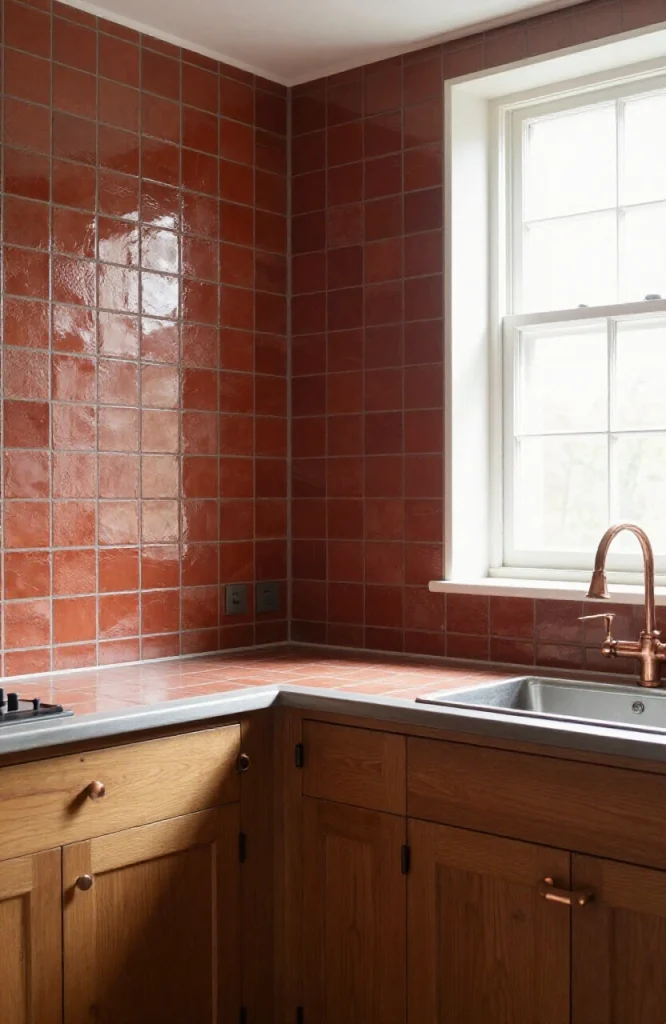
Reclaimed brick or a high-quality brick-effect ceramic tile in a stretcher bond layout. The red-brown warmth of brick reads as Victorian scullery or kitchen extension, the most utilitarian end of the Victorian kitchen spectrum. Pairs well with exposed brick walls, cream painted cabinetry, and cast-iron or copper fixtures.
Victorian Kitchen Backsplash and Wall Ideas
28. White Subway Tile with a Victorian Floral or Geometric Border Row
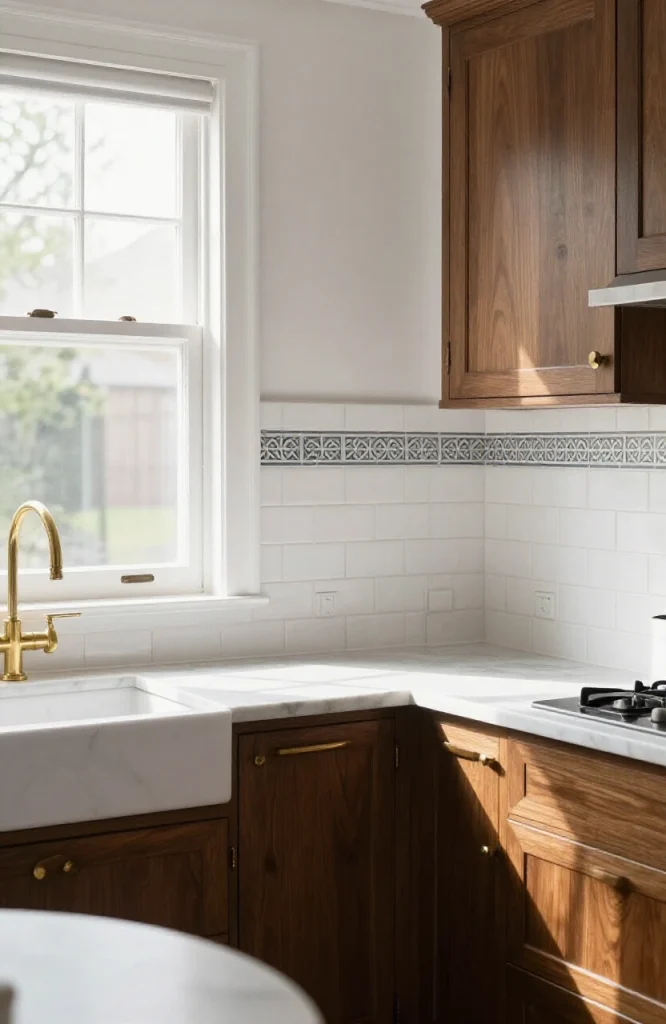
Standard 75×150mm white subway tile across the full backsplash zone. At eye level — typically one course above the countertop or centered between counter and upper cabinets — insert a single row of handmade decorative border tile in a floral or interlocking geometric motif. The field tile stays neutral and cost-effective; the border provides the period reference.
29. Floral or Damask Wallpaper Above a Painted Wainscot Rail
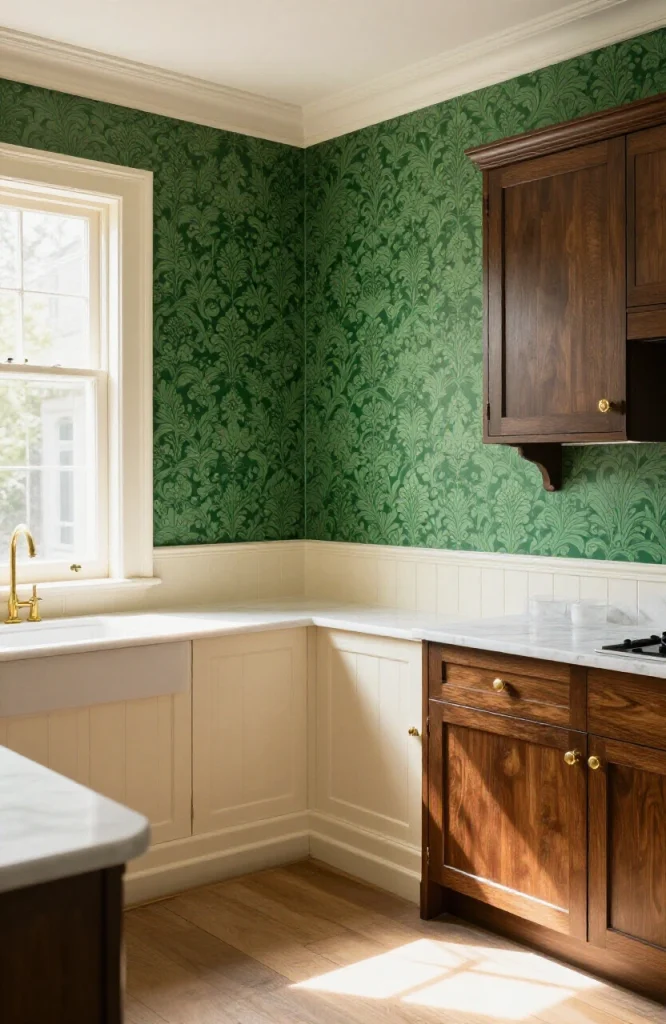
Paint the lower wall section to dado rail height in the same color as the cabinets or a complementary tone. Above the rail, apply a Victorian floral or damask wallpaper — William Morris-pattern reproductions are widely available and dimensionally stable in kitchens with good ventilation. Use it on one wall behind open shelving or a built-in bench rather than all four surfaces.
30. Handpainted Tile Backsplash with Botanical, Bird, or Geometric Motifs
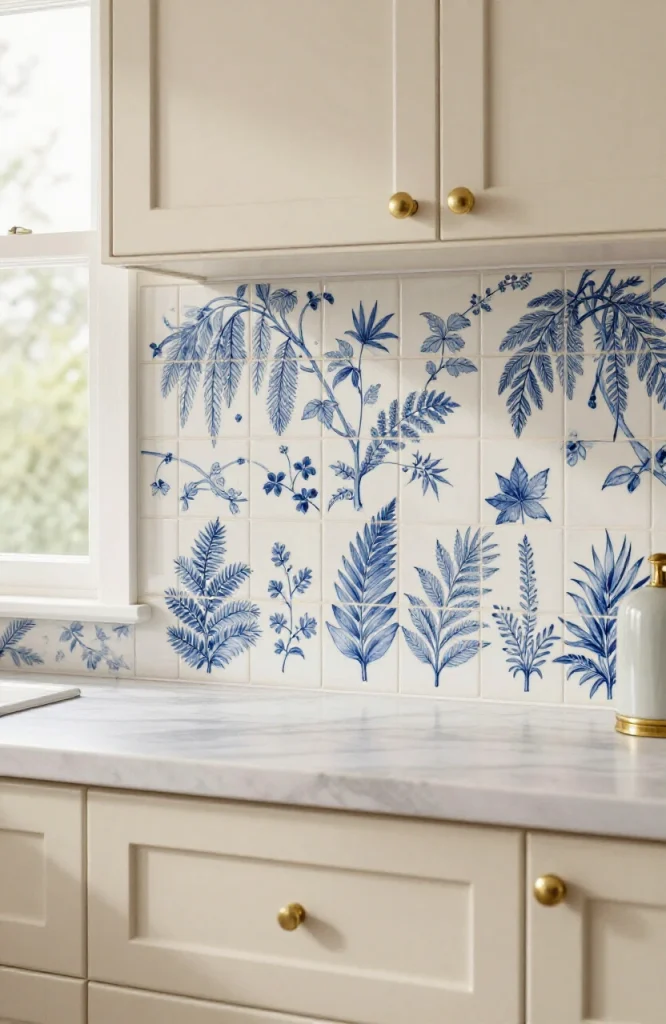
Hand-painted ceramic tiles in a repeating botanical (willow pattern, fern, or flower), bird, or geometric design tiled across the full backsplash. Each tile functions as a small artwork. Works best when the cabinetry is a single unbroken color — dark green, cream, or black — so the tile pattern has visual space to read across the whole surface.
31. Beadboard Wainscoting in White or Sage to Counter Height
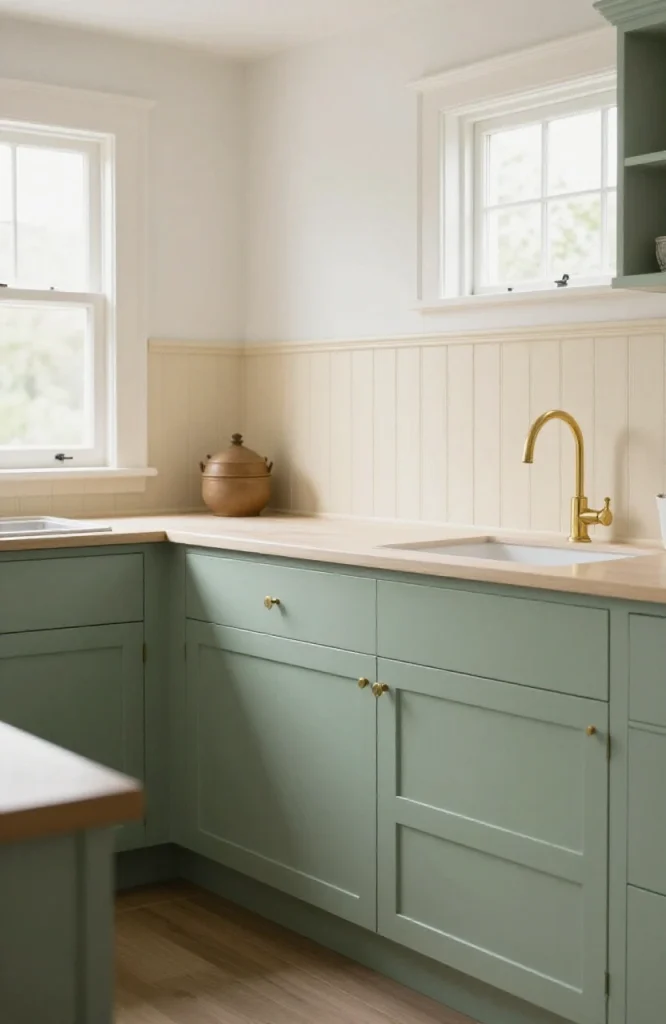
Vertical tongue-and-groove beadboard paneling from floor level to countertop height, capped with a small chair rail molding. Painted white it brightens the lower portion of the room. In sage green it creates a full color-drenched base. Add a simple cornice molding at the top of the beadboard for period accuracy. Works as both wall treatment and a replacement for lower cabinet cladding in older kitchens.
32. Exposed Brick Behind the Range Where Original Brick Is Present
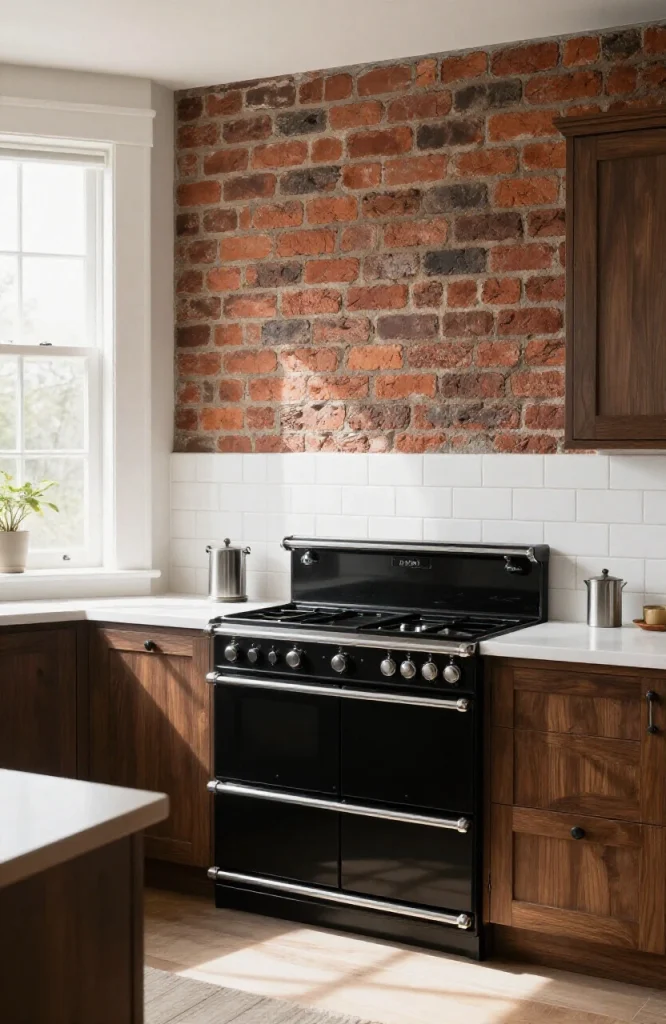
Where a wall behind the range position conceals original Victorian brickwork, remove the plaster and seal the brick in a matte clear finish. The texture and warm red-brown of old brick works with dark cabinetry and brass hardware without any additional decoration. Do not paint the brick — the raw material is the point. New kitchens can achieve the same look with reclaimed London stock brick slips.
Victorian Kitchen Lighting Ideas
33. Wrought-Iron Chandelier Over the Kitchen Island
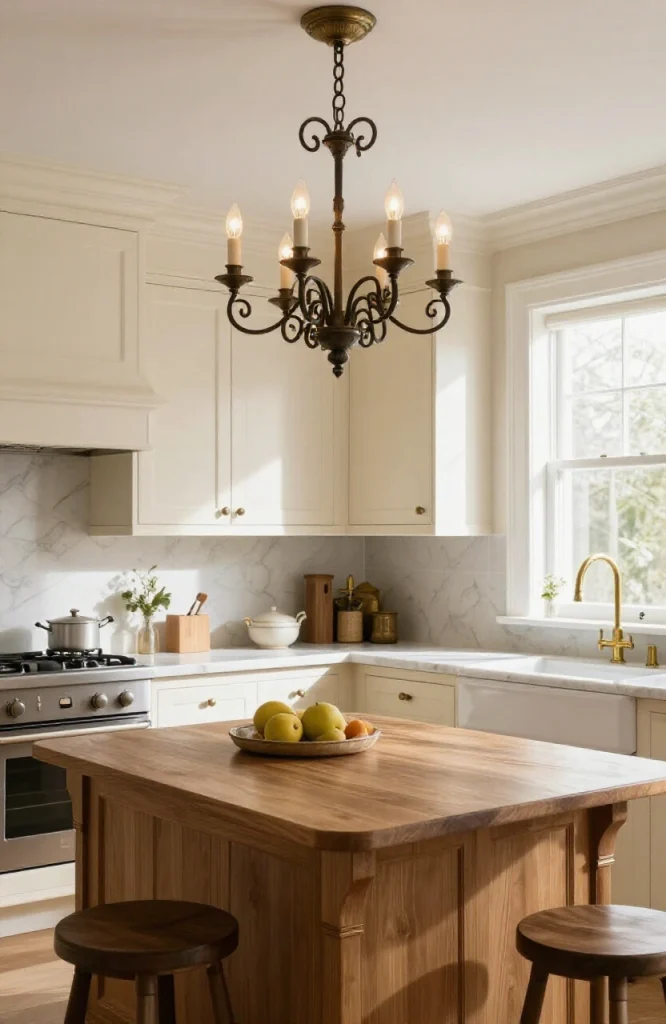
A multi-arm wrought iron chandelier with candle-style bulbs hung centered above the island. Scale: the fixture should be roughly half the island’s length and hung so the bottom of the fitting is 750mm–900mm above the countertop surface. Dimmable candle-style LED bulbs in a warm 2200K color temperature replicate the period quality of candlelight without fire risk.
See also:14 Small Kitchen Design Ideas
34. Brass Pendant Lights with Clear or Amber Glass Globe Shades
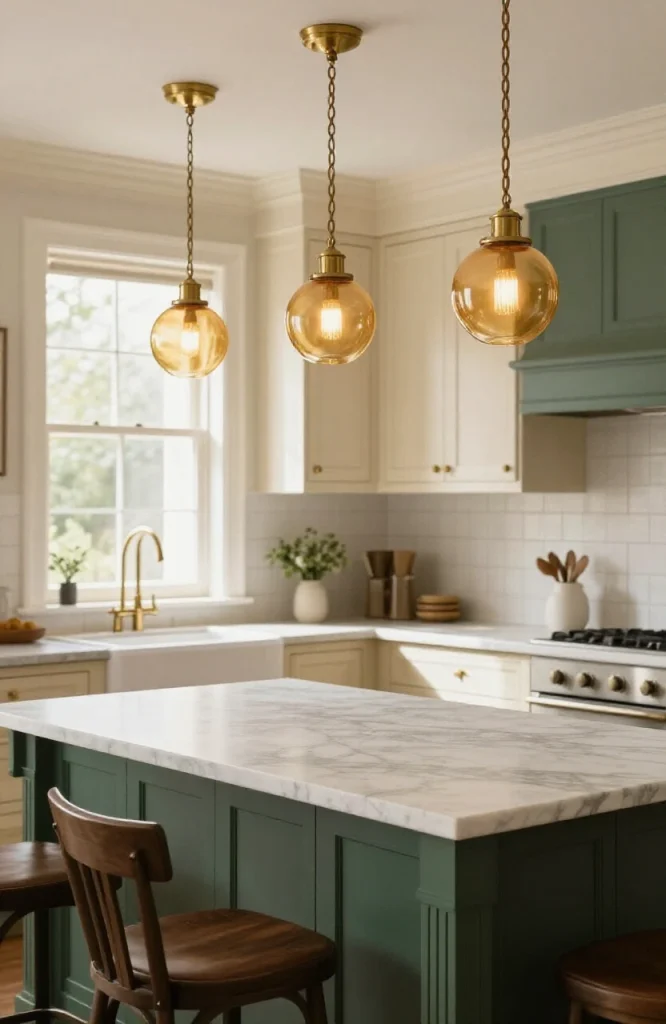
Antique or satin brass pendants with clear or amber-tinted glass globe shades, hung in a row of three above an island or two flanking a window over the sink. The globe shade fills the pendant visually in a way a bare bulb does not. Amber glass adds warmth and is the more period-accurate choice. Clear glass reads slightly more contemporary but shows the filament bulb clearly.
35. Wall Sconces Flanking the Range Hood for Symmetry and Task Light
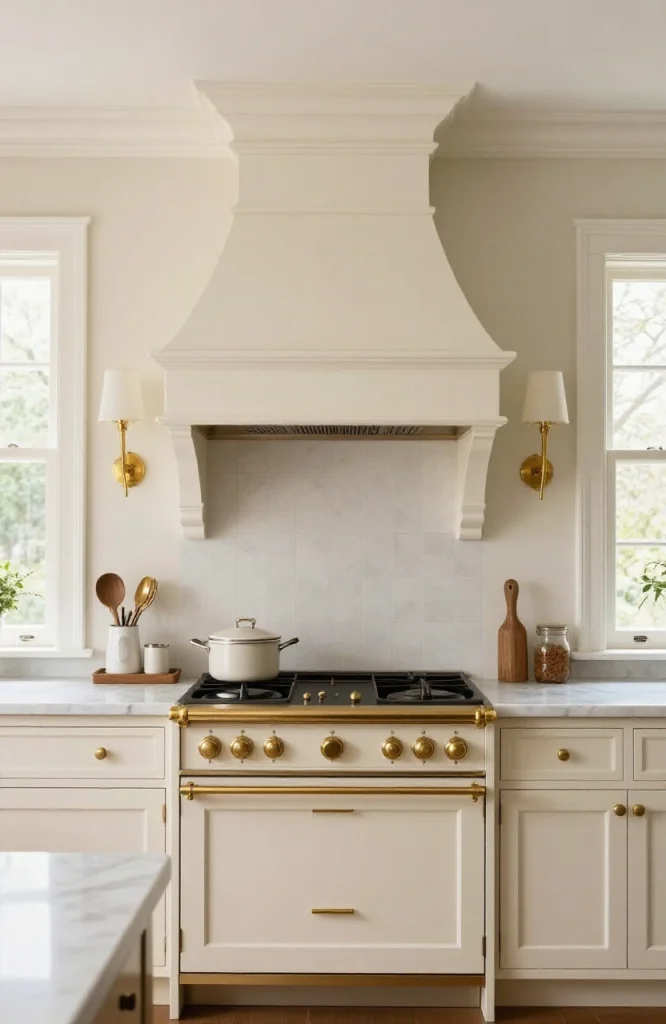
A pair of brass or oil-rubbed bronze wall sconces mounted at equal heights on either side of the range hood, 200mm–300mm from the hood’s outer edge. They provide supplementary task light at the range and enforce the symmetry that Victorian design depends on. A candle-style or small globe shade is period-accurate; a flat disc shade reads too contemporary against a paneled hood.
36. Lantern-Style Pendant Above the Sink as a Single Low-Cost Victorian Reference
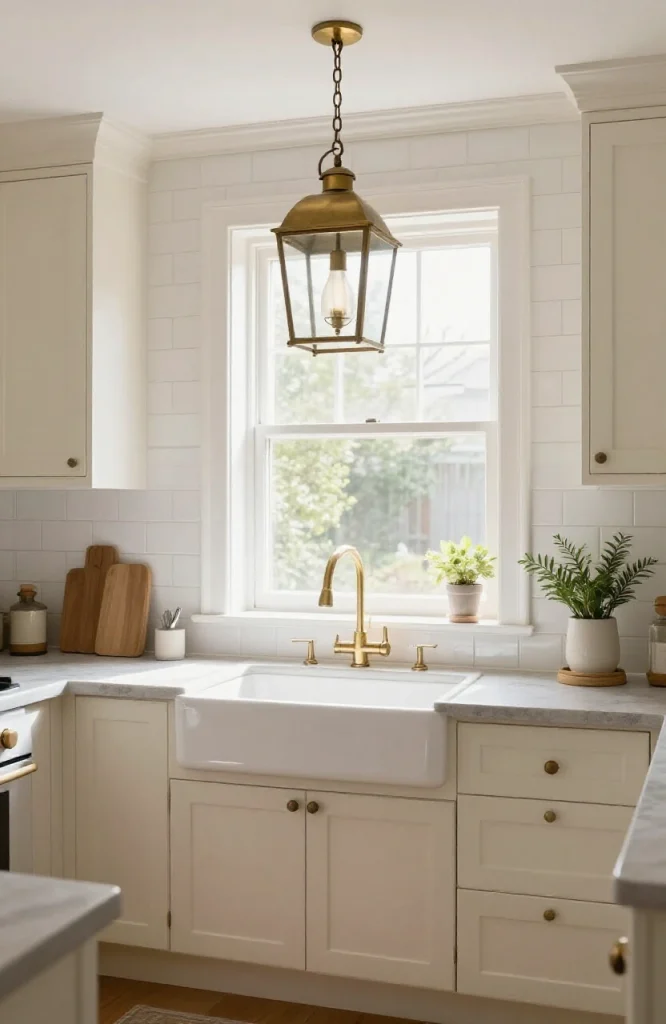
One large lantern pendant in aged brass or black iron, hung above the sink on a long rod or chain to bring it down to a functional height. This is the simplest and lowest-cost Victorian lighting addition available. In an otherwise neutral kitchen it reads as a period detail; in a full Victorian kitchen it reinforces the lantern shapes used throughout the rest of the room
Small and Budget-Friendly Victorian Kitchen Ideas
37. Freestanding Hutch or Kitchen Dresser as a Victorian Storage Statement
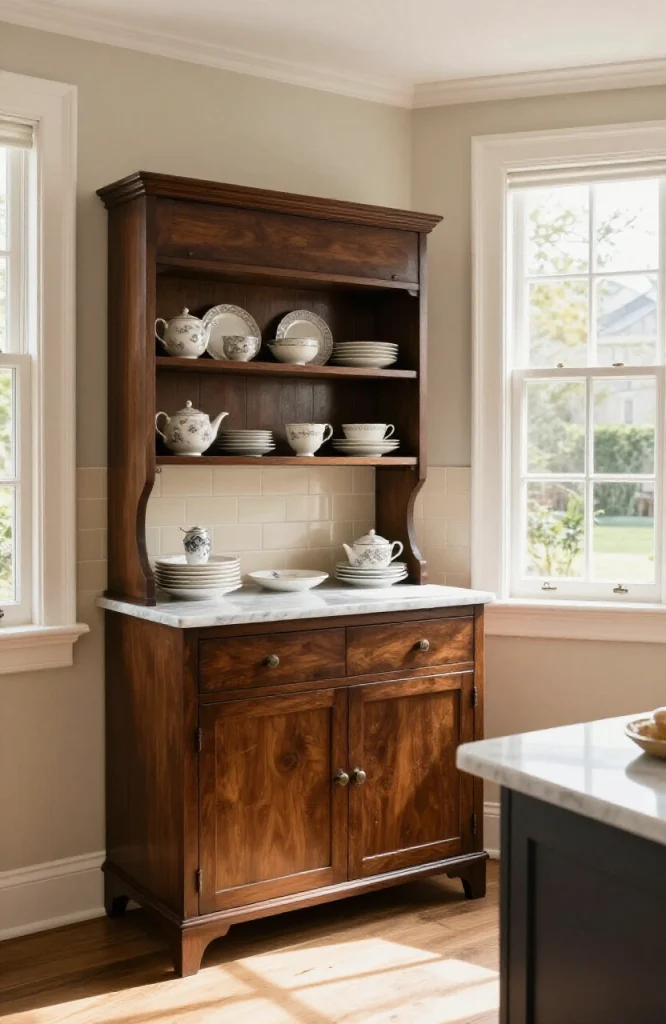
A solid wood kitchen dresser — upper shelves open for display, lower section solid doors or drawers — in dark green, cream, walnut, or mahogany. Position it on the wall opposite the main run of fitted cabinets. No construction work required. It brings Victorian furniture character to an otherwise flat fitted kitchen and provides genuine storage in one move.
38. Replace All Hardware with Antique Brass Bin Pulls or Porcelain-Brass Knobs
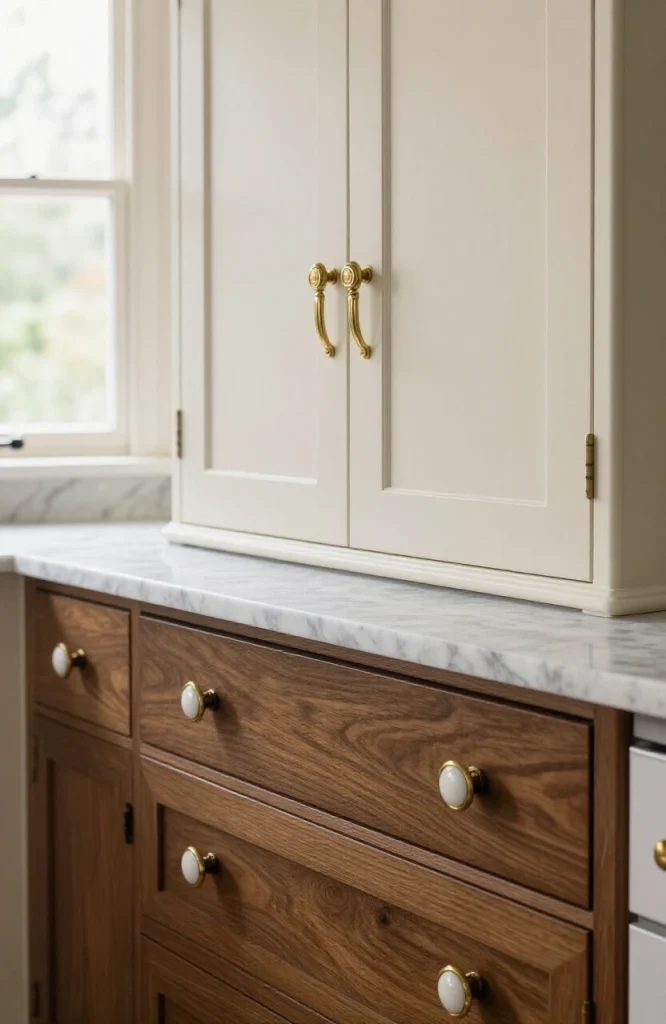
Swapping brushed nickel or chrome hardware for antique brass bin pulls at 96mm–128mm centers, or porcelain knobs with a brass backplate, is the lowest-cost Victorian upgrade in any kitchen. It takes an afternoon with a screwdriver. The visual shift is disproportionate to the cost because hardware appears in every photograph and catches the eye at every cabinet interaction.
39. Peel-and-Stick Encaustic-Pattern Tile for Rented Kitchens
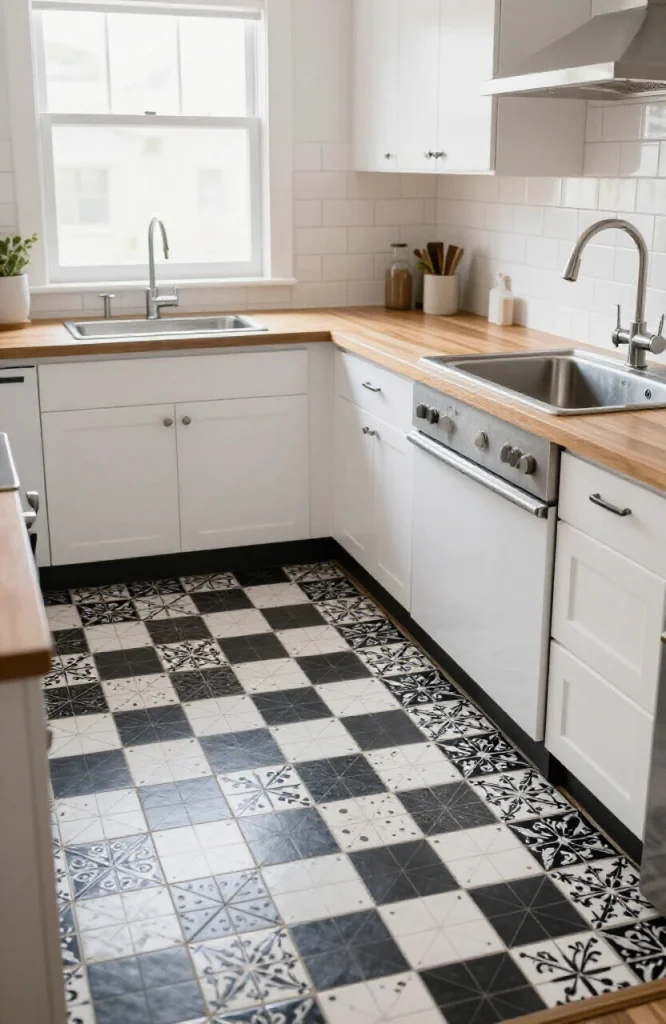
Self-adhesive vinyl tile in a Victorian checkerboard or geometric pattern applied to a clean, primed floor or backsplash surface. Current quality products, when applied correctly to a grease-free surface with proper adhesion preparation, hold well for several years without curling. Removable without damage to the surface underneath, which makes them the only option in a rented property. Replace in sections when any tile lifts.
40. Open Shelving on Ornate Bracket Supports with Period Dishware Styling
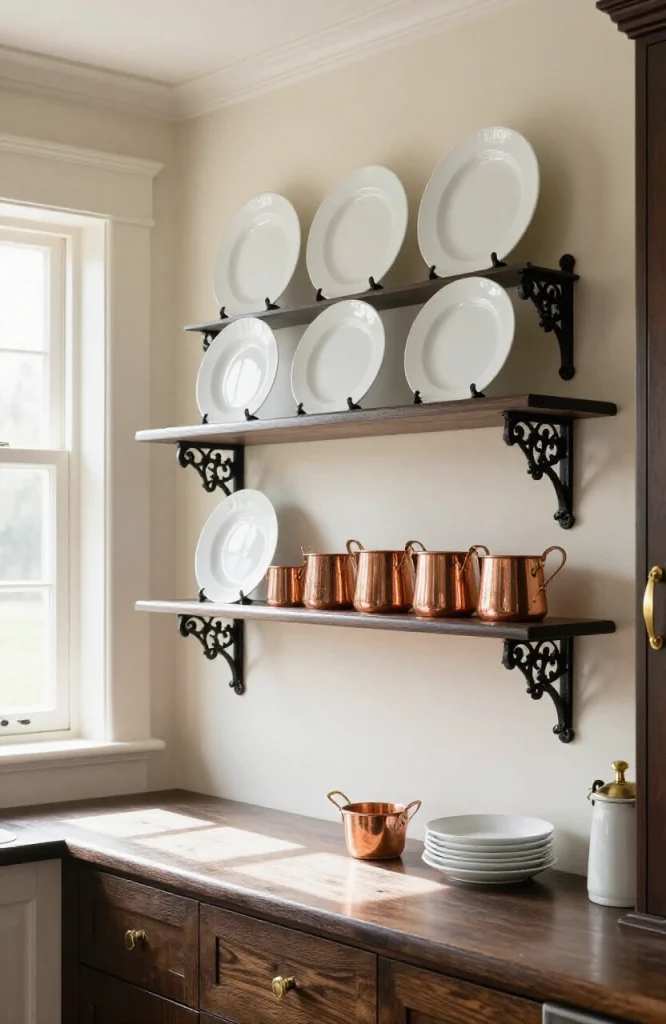
Remove one or two upper cabinet doors and replace with open shelves supported on cast-iron or carved wood bracket supports fixed to the wall. Style with stacks of white ironstone plates, copper measuring cups, glass storage jars with metal lids, and bundles of dried herbs. The bracket supports carry the period character; the shelving itself is a standard timber board. No cabinetry budget required.
Victorian Kitchen Cabinets: What to Look For
Cabinet choice determines whether the rest of the design works. The main decisions are wood species, door profile, and finish.
Wood species. Mahogany and walnut are the most traditional choices. Oak is a slightly lighter option that stains well. For painted cabinets, the wood species matters less, but MDF doors with applied molding are far less durable than solid wood in a working kitchen.
Door profiles. Raised-panel doors are the most period-accurate. Beadboard panels are a softer, more cottage-style alternative. Shaker doors work in a Victorian context when the surrounding details, such as crown molding, glass inserts, and hardware, are strong enough to carry the style.
Hardware. Antique brass is the default. Unlacquered brass, which develops a patina over time, is the most authentic choice. Porcelain knobs with brass backplates, bin pulls, and cup pulls all have Victorian precedent. Avoid brushed nickel and chrome, which read as too modern against period cabinetry.
Crown molding. Crown molding at the top of ceiling-height cabinets is non-negotiable in a classic Victorian kitchen. In a modern Victorian space, a simpler molding profile adds the same structural finish without the visual weight.
| Feature | Traditional Victorian | Modern Victorian |
|---|---|---|
| Door style | Raised panel with carved detail | Shaker or beadboard |
| Wood finish | Dark stain: mahogany, walnut | Painted: dark green, navy, cream |
| Hardware | Antique brass bin pulls | Unlacquered brass bar pulls |
| Crown molding | Dentil or egg-and-dart profile | Simple ogee or cove profile |
| Glass inserts | Yes, clear or frosted | Optional |
Victorian Kitchen Flooring: Best Options Compared
The floor is the first thing that sets a Victorian mood when you walk in. Start here before committing to cabinet colors, because it is much easier to match cabinets to a floor than the reverse.
Checkerboard encaustic tile is the most authentic choice and one of the most durable. The contrast between black and white reads strongly in both large and small kitchens.
Wide-plank hardwood in a dark stain adds warmth and works naturally with dark cabinetry. It is the better choice if the kitchen connects to adjacent rooms with wood floors.
Geometric Victorian ceramic tile is the boldest floor option and works best when the cabinetry is a solid, relatively calm color.
Chevron or herringbone wood sits between the pattern of tile and the plainness of wide plank. It adds visual interest without the contrast of a two-color tile floor.
What to avoid. Large-format light gray porcelain is the most common flooring choice in modern kitchen renovations and the one most at odds with Victorian style. Gray LVP (luxury vinyl plank) in narrow strips also drains the period character from any room. If budget limits the options to vinyl, choose a wood-effect in a dark warm tone or a tile-effect in a checkerboard pattern.
Victorian Kitchen Countertops and Backsplash Pairings
Countertops and backsplashes need to read as a pair rather than two separate decisions. These four combinations cover the most common Victorian kitchen configurations:
Marble countertops + dark wood cabinets + white subway tile with a floral border. The cool marble provides contrast against warm dark wood. The subway tile is neutral enough to let the border do the decorative work.
Granite countertops + cream painted cabinets + handpainted geometric tile backsplash. The granite adds natural variation in color and texture. The cream cabinets keep the room bright, and the geometric backsplash provides the Victorian reference.
Butcher block countertops + white shaker cabinets + floral wallpaper above wainscoting. Butcher block in an oiled finish reads as period-appropriate and practical. The white shaker cabinets keep the room light, and wallpaper above the counter zone provides warmth.
White quartz countertops + navy lower cabinets + brass fixtures throughout. The contrast between white quartz and navy is sharp and contemporary, but brass hardware and crown molding keep it in Victorian territory.
How to Mix Victorian Style with a Modern Kitchen
A kitchen that needs to function well for a busy household does not have to sacrifice any modern convenience to achieve a Victorian look. The two approaches that work best are paneling appliances and choosing retro-inspired models.
Panel your appliances. A refrigerator and dishwasher behind cabinet panel doors that match the rest of the kitchen disappear completely. This is the single most effective way to maintain a period look while keeping modern appliances.
Choose retro-inspired models. Brands such as Smeg, Elmira, and Big Chill make refrigerators and ranges with rounded forms and period color options that complement rather than contradict a Victorian kitchen. Stainless steel works when it is surrounded by warm wood and ornate trim but looks out of place against flat, pale cabinetry.
Use hardware as the upgrade. If a full renovation is not possible, brass hardware, a decorative range hood, and crown molding on the existing cabinet tops are the three changes with the highest visual return per pound or dollar spent.
Layer textiles and rugs. A wool runner in front of the range, linen curtains at the kitchen window, and a small upholstered chair or bench in a breakfast nook area add the warmth and layering that Victorian interiors depended on.
Victorian Kitchen Design Tips Before You Start
These five points save time and prevent expensive decisions that have to be reversed.
Decide on your flooring first. The floor anchors every other color decision in the room. Dark mahogany cabinets look different above a checkerboard tile than above a dark herringbone wood floor. Lock the floor choice before finalizing cabinet color.
Budget an extra 10% cushion. Victorian kitchen renovations often include structural discoveries, such as original tile under a later floor or period plasterwork that needs repair. A 10% contingency on top of the planned budget covers these without derailing the project.
Dark cabinets need adequate space. A kitchen under roughly 10 square meters with dark floor-to-ceiling cabinets on all four walls will feel oppressive rather than dramatic. Use dark colors on the lower cabinets only, or introduce lighter upper cabinets to open the room.
Balance ornate cabinetry with simpler surfaces. If the cabinets are heavily carved and dark, the countertops and backsplash can afford to be simple and light. Marble with minimal veining or plain subway tile lets the cabinetry read clearly.
Use vertical height in small kitchens. Ceiling-height cabinets with crown molding, tall shiplap or beadboard paneling, and vertical window treatments all draw the eye upward and make a small kitchen feel more generous. This is more effective than trying to create a sense of space by using pale colors alone.
For more design guides across every room, visit the guides section on this site.
Frequently Asked Questions About Victorian Style Kitchens
What makes a kitchen look Victorian?
The clearest markers are dark or richly colored cabinetry with ornate molding detail, patterned tile on the floor or backsplash, brass hardware throughout, and statement lighting such as a chandelier or lantern-style pendants. Crown molding at the ceiling and a decorative range hood reinforce the period character. A kitchen with all modern fittings but antique brass hardware and a Victorian tile floor still reads closer to the style than one with dark cabinets and no other period details.
What colors are used in a Victorian kitchen?
The traditional palette centers on dark, rich tones: burgundy, forest green, navy blue, chocolate brown, and black. These appear most often on cabinets and walls. Cream, ivory, soft gray, and powder blue are the lighter alternatives used in more contemporary interpretations. Gold, brass, and deep red appear throughout as accent colors in hardware, lighting, and tile.
Can you have a Victorian kitchen in a small house?
Yes. The key adjustments are using dark colors on lower cabinets only, choosing lighter colors for upper cabinets, adding tall vertical elements such as ceiling-height cabinets with crown molding, and keeping the backsplash and countertops relatively simple. An open shelf unit or freestanding hutch in a period finish adds Victorian character without the visual weight of a full run of dark fitted cabinets.
Are Victorian kitchens hard to keep clean?
Only if the materials are not chosen carefully. Ornate carved cabinet frames accumulate grease and dust, so a sealed or lacquered finish is important. Patterned tile floors with dark grout are more forgiving than light grout on a high-use kitchen floor. Marble countertops need sealing and are not ideal near a range where oil and acids are common. Stone with a matte or honed finish shows fewer water marks than a polished surface.
Can I use modern appliances in a Victorian style kitchen?
Yes, with two conditions. Either panel them behind matching cabinet doors so they are not visible, or choose appliances specifically designed with a retro aesthetic. Stainless steel can work if the kitchen has enough warm wood tone and ornate detail to absorb the contrast, but it is the hardest material to make look period-appropriate.
What is the best flooring for a Victorian kitchen?
Checkerboard encaustic tile is the most historically accurate. Wide-plank hardwood in a dark stain and multi-color geometric ceramic tile are both strong alternatives. The one floor to avoid is the large-format light gray porcelain tile that dominates current kitchen renovation trends, as it reads as entirely contemporary and removes any period character the rest of the room has established.
How much does a Victorian kitchen renovation cost?
Costs vary enormously by country and specification. A budget approach using painted shaker cabinets, antique brass hardware, a patterned tile floor, and crown molding can cost between £8,000 and £15,000 in the UK or $12,000 to $22,000 in the US for a medium-sized kitchen. A full renovation with custom carved cabinetry, marble countertops, handpainted tile, and paneled appliances can exceed £40,000 or $60,000. The single highest-return investment is cabinetry, so allocate budget there before spending on decorative accessories.
Final Notes
Victorian style kitchen ideas cover a broad range, from faithful period recreations with mahogany cabinetry and encaustic tile floors to modern kitchens that borrow only a checkerboard floor and brass hardware. The common thread across all of them is intentionality: every surface, fitting, and finish earns its place.
Start with the floor, lock in the cabinet color and profile, then build the hardware, lighting, and backsplash around those two anchor decisions. That sequence prevents the mismatches that make Victorian kitchens feel costume-like rather than coherent.
If you are planning other rooms in the same property alongside the kitchen, the home decor blog covers color, furniture, and room-by-room design ideas that can help keep the whole house feeling consistent.